

contexts
Button or coin batteries (hereinafter collectively referred to as "button/coin batteries") are used in a wide variety of consumer products and present a number of product safety risks, particularly the risk of swallowing such batteries by children. If swallowed, these batteries can burn through a child's throat or esophagus in as little as two hours.Between 2011 and 2021, the U.S. Consumer Product Safety Commission (CPSC) is aware of 27 deaths and approximately 54,300 related emergency room visits associated with button/coin batteries.
In September 2023, in an effort to reduce the risk of children six years of age and younger swallowing button/coin batteries, the CPSC voted under the Reese's Law to approve a mandatory standard adopting the voluntary standard ANSI/UL 4200A-2023 "Standard for Safety for Products Incorporating Button Batteries or Coin Cell Batteries" as the mandatory safety requirement for "Consumer Products Containing Button/Coin Cell Batteries". Safety for Products Incorporating Button Batteries or Coin Cell Batteries" as a mandatory safety requirement for "Consumer Products Incorporating Button/Coin Cell Batteries". CPSC has also established labeling requirements for "Button/Coin Cell Batteries" and their packaging to warn children of the dangers of swallowing them.
deal
Merchants should be aware of and comply with the mandatory standards approved by the CPSC under the Reese's Law, as well as the labeling requirements for packaging, to ensure that their products are compliant in the U.S. market.
Compliance Guide
The U.S. compliance requirements for button/coin batteries and consumer products containing such batteries are primarily based on the Reese's Law, 16 CFR Part 1263, and the Final Rule on Safety Standards for Button or Coin Batteries and Consumer Products Containing Such Batteries (88 FR 65296).
(i) Product range
Any button/coin batteries sold into the U.S. market and consumer products containing button/coin batteries are covered.
Note that this range does not apply to "zinc-air button cells or coin batteries," but such batteries are still subject to the requirements of 16 CFR § 1700.15 Special Packaging.
One of them is the Button Cell / Coin Battery (Button Cell / Coin Battery):
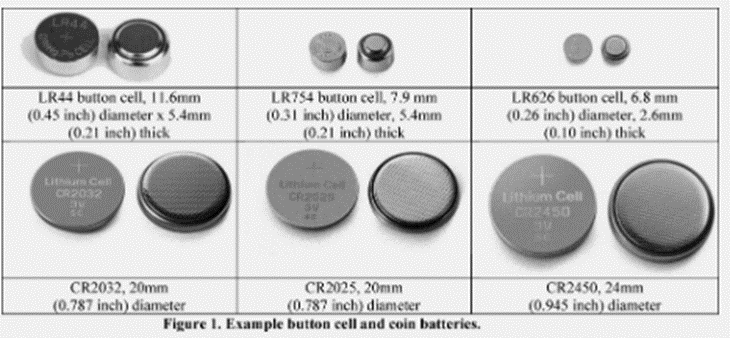
- A single cell with a diameter greater than the cell height;
- Any other battery that the CPSC determines poses an ingestion hazard, regardless of the technology used to generate the charge.
The Ingestion hazard described above is a hazard caused by an individual swallowing or inserting a button/coin cell into the body, specifically:
- Button/coin batteries may become lodged in the digestive tract or airway;
- May cause death or serious injury through asphyxiation, generation of hazardous chemicals, leakage of hazardous chemicals, electrochemical burns, crushing necrosis, or other means.
Consumer Product containing button cell or coin batteries means a consumer product that contains or is designed to use one or more button/coin batteries, whether or not such batteries need to be replaced by the consumer, are included in the product, or are sold separately.
An example of a button/coin battery is shown below:
(ii) Requirements for Consumer Goods Containing Buttons/Coin Cells
1. General Requirements
Pursuant to the requirements of Section 2 of the Reese's Law, the CPSC established 16 CFR Part 1263 for button/coin batteries and consumer products incorporating such batteries, 16 CFR Part 1263.3 of which requires that "Consumer Products Incorporating Button/Coin Cell Batteries 16CFR Part 1263.3 requires that "Consumer products incorporating button/coin batteries" comply with the safety standard ANSI/UL 4200A-2023 "Standard for Safety for Products Incorporating Button Batteries or Coin Cell Batteries. "Standard for Safety for Products Incorporating Button Batteries or Coin Cell Batteries".
Requirements for consumer products that contain or are designed to use button/coin batteries per ANSI/UL 4200A-2023 include, but are not limited to:
- Battery compartments containing replaceable button/coin batteries must be reinforced and require the use of a tool (e.g., screwdriver) or at least "two separate and simultaneous hand movements" to open;
- The battery compartment needs to be designed in such a way that the button/coin batteries will not fall out or be easily removed by "product use" and "abuse testing";
- The entire product package shall bear a warning label;
- If feasible, the product itself should carry a warning label;
- The accompanying instruction manual and handbook must contain all applicable warnings.
Merchants can obtain a read-only copy of ANSI/UL 4200A-2023 at www.ulstandards.com/IBR/logon.aspx to further obtain specific button/coin battery safety standards, testing requirements, packaging, warning label details, and instruction manual requirements.
2. Warning labels
"Consumer products containing button/coin batteries" are required to meet the labeling standards of ANSI/UL 4200A-2023, including but not limited to:
①Packaging and labeling requirements
i. If the main display panel is large enough, the following labels are required to be displayed on the packaging of products containing button cell batteries (choose one of the two)
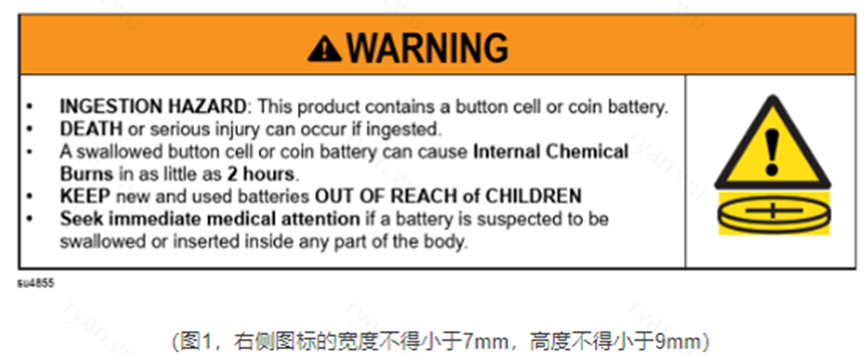
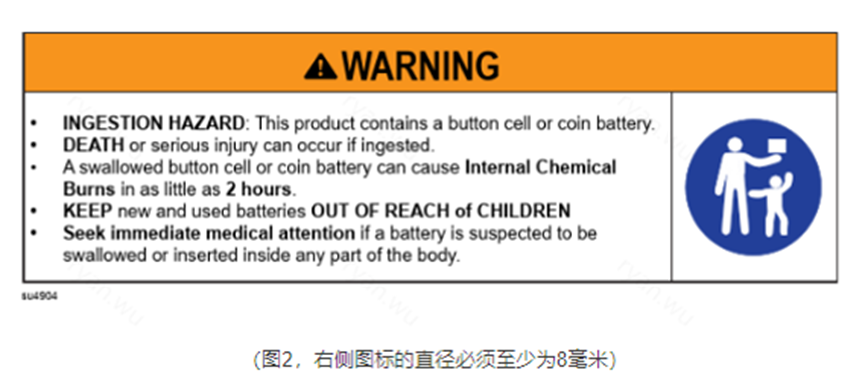
NOTE: If products containing button cell batteries are not packaged, the above warning label should be displayed on the hang tag or attached to the product itself using a self-adhesive label.
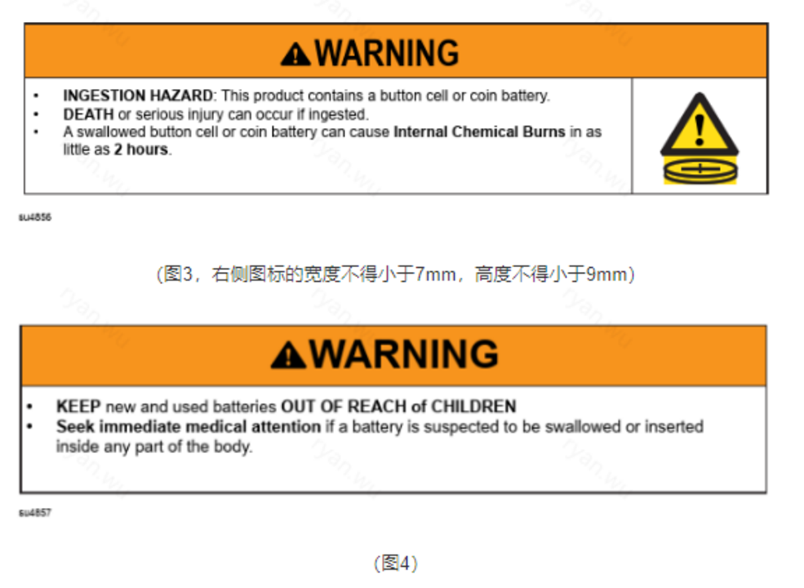
ii. If space does not permit the display of the full warning labels shown in Figures 1 or 2, the warning labels shown in Figure 3 shall be placed on the main display panel of the package, and the warning labels shown in Figure 4 shall be placed on other display panels:
iii. The following information shall also be included on the packaging of products containing button cell batteries or, if there is no packaging, on the hangtag or self-adhesive label attached to the product:
  a) For products containing non-replaceable batteries, a statement that the product contains non-replaceable batteries;
  b) Battery type (e.g. LR44, CR2032);
  c) Rated voltage
②Product labeling requirements
  Products containing button batteries must also display the following warning label on the product itself. iv. If space is not available, the following warning label must be displayed on the product itself:
iv. If space does not permit the display of a complete warning label as shown in Figure 5, an alternative label as shown in Figure 6 shall be displayed on the product itself and the meaning of the label shall be stated in the accompanying printed materials (e.g., instruction manuals, brochures, inserts, or hang tags):
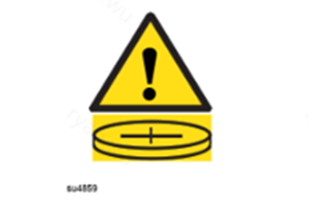
v. If space is too small to permit the display of the warning labels shown in Figures 5 and 6, the package labeling requirements described above shall be met.
Note: All of the above labels should be made sure that they remain legible after being wiped manually with a cloth moistened with water for 15 seconds and with a cloth moistened with petroleum ether (a petroleum solvent) for 15 seconds, and that if they are on detachable labels, they should not be curled and cannot be removed manually.
3. Exemptions from security standards
For toy products intended for use by children under 14 years of age, the current safety standards in 16 CFR Part 1263 may be waived if the battery accessibility and labeling requirements in 16 CFR Part 1250 are met.
(C) Button/Coin Cell Product Requirements
1. Packaging requirements:
Section 3 of the Reese's Law requires that any "button/coin batteries" manufactured, imported, or distributed after February 12, 2023 (including such batteries that are accompanied by other consumer products but are individually packaged) be specially packaged to comply with the requirements of 16 CFR Part 1700.15 (the Poison Packaging Prevention Act). - Testing for the special packaging requirements of the PPPA does not need to be conducted by a CPSC-accredited third-party laboratory, and merchants may also refer to the Poison Packaging Prevention Act (PPPA) Business Guidance page for more information.
2. Labeling requirements
As required by section 2 of the Reese's Law, on September 21, 2023, CPSC promulgated a separate final rule, "Final Rule on Safety Standards for Button or Coin Batteries and Consumer Products Containing Such Batteries" (88 FR 65296), which establishes warning labeling requirements for the packaging of button/coin batteries, including those batteries that are accompanied by other consumer products, but which are packaged separately. The final rule will partially amend 16 CFR 1263 and add 16 CFR 1263.4 to the "Labeling Requirements for Button/Coin Batteries and Their Packaging," which consists primarily of:
a) General requirements
(1) All warning statements must be clearly visible, prominent, easy to read, and permanently marked.
(2) The color of the warning statement must contrast with the color of the background on which it is printed.
(3) A warning statement must be in English.
(4) The Safety Warning Symbol, the exclamation mark in the triangle (below), when used with Signal words, must be placed before the Signal words. The bottom of the Safety Warning Symbol must be at the same level as the bottom of the Signal word letters. The height of the safety warning symbol must equal or exceed the height of the signal word letters.
(5) The signal word "WARNING" and the safety alert symbol must be black letters on an orange background (as shown below), unless this conflicts with the requirements of (1) and (2) above, or there is only one color present, in which case the signal word and the safety alert symbol must be in contrast to the background on which they are printed. (b) the signal words and safety warning symbols must be contrasted with the background on which they are printed. Signal words must appear in sans-serif capital letters.
(6) Certain text in the warning must be bolded and in capital letters to attract the attention of the reader. For details, see (b) below for a sample diagram of warning labeling requirements.
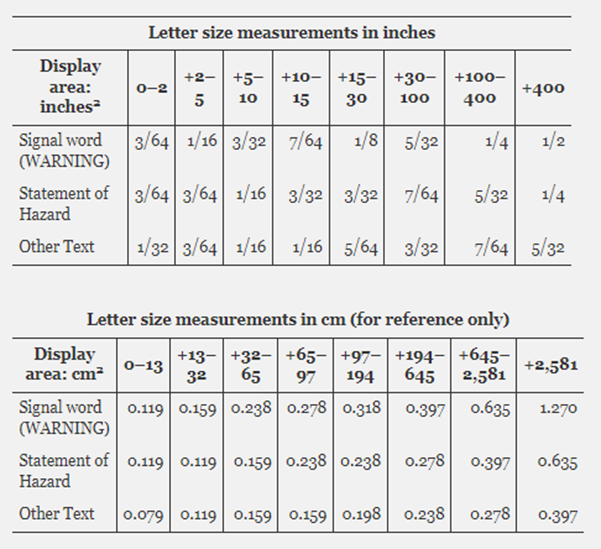
(7) For labels that need to be affixed to button/coin batteries and coin battery packs, the text size must be determined by the area of the main display panel. You can refer to the following information:
b) Warning labeling requirements
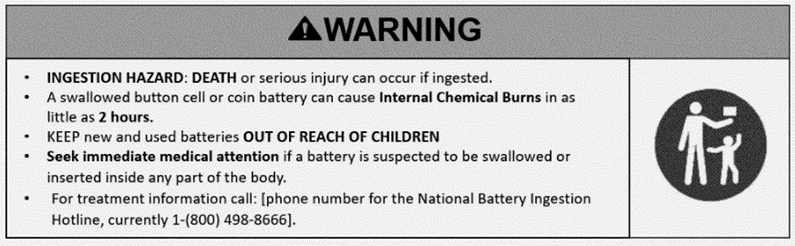
(1) The main display panel of the package must contain the warning label and warning shown below. The icon must be at least 8 millimeters (0.3 inches) in diameter.
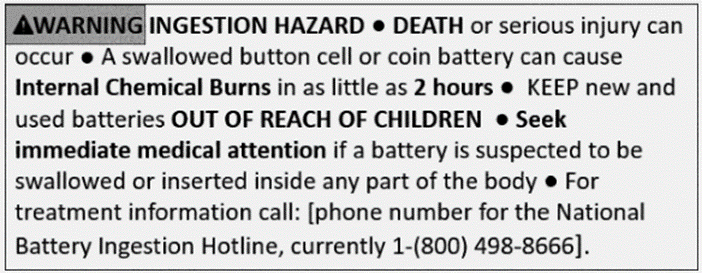
(2) If the space does not allow to place the full warning label of the above figure, then the icon of the next figure must be placed on the main display panel with a diameter of at least 20 mm. And place the text of the following figure on the secondary display panel:
(3) The following safety-related statements must be included on the primary display panel or secondary display panel:
(i) Keep in original package until ready to use.
(ii) Immediately dispose of used batteries and keep away from children. Do NOT dispose of batteries in household trash.
Please note that the above safety-related statements do not need to be included for packaging with button/coin batteries that come with other consumer products but are packaged separately.
(iv) Qualifications and Certification Requirements
For button/coin batteries and consumer products containing such batteries sold to the U.S., merchants are required to have a General Certificate of Compliance (GCC) and to certify that the product complies with the applicable standards listed above; if the consumer product is a children's item that is not a toy, merchants are required to have the Children's If the consumer product is a non-toy children's product, the trader needs to have a Children's Product Certificate (CPC) and prove that the product complies with the above applicable standards.
The following regulatory/standard requirements need to be met: 16 CFR Part 1700.15 (Poison Resistant Packaging Standard), 16 CFR Part 1700.20 (Special Package Test Procedures), ANSI C18.3M (Safety Standard for Portable Lithium Ion Primary Batteries and Batteries).
Reference Links:
- Business Guide for Button and Coin Batteries
Button Cell and Coin Battery Business Guidance - Final Rule - Safety Standards for Button or Coin Cells and Consumer Products Containing Such Cells
Safety Standard for Button Cell or Coin Batteries and Consumer Products Containing Such Batteries - 16 CFR Part 1263 - Safety Standards for Button or Coin Cells and Consumer Products Containing Such Cells
part 1263-safety standard for button cell or coin batteries and consumer products connecting such batteries - 16 CFR Part 1700.15 - Standard for Antivirus Packaging
16 CFR§ 1700.15 Poison prevention packaging standards. - Reese's Law.
Pub. L. 117-171, 15 U.S.C. 2056e
 EN
EN  ZH_TW
ZH_TW  ZH
ZH