
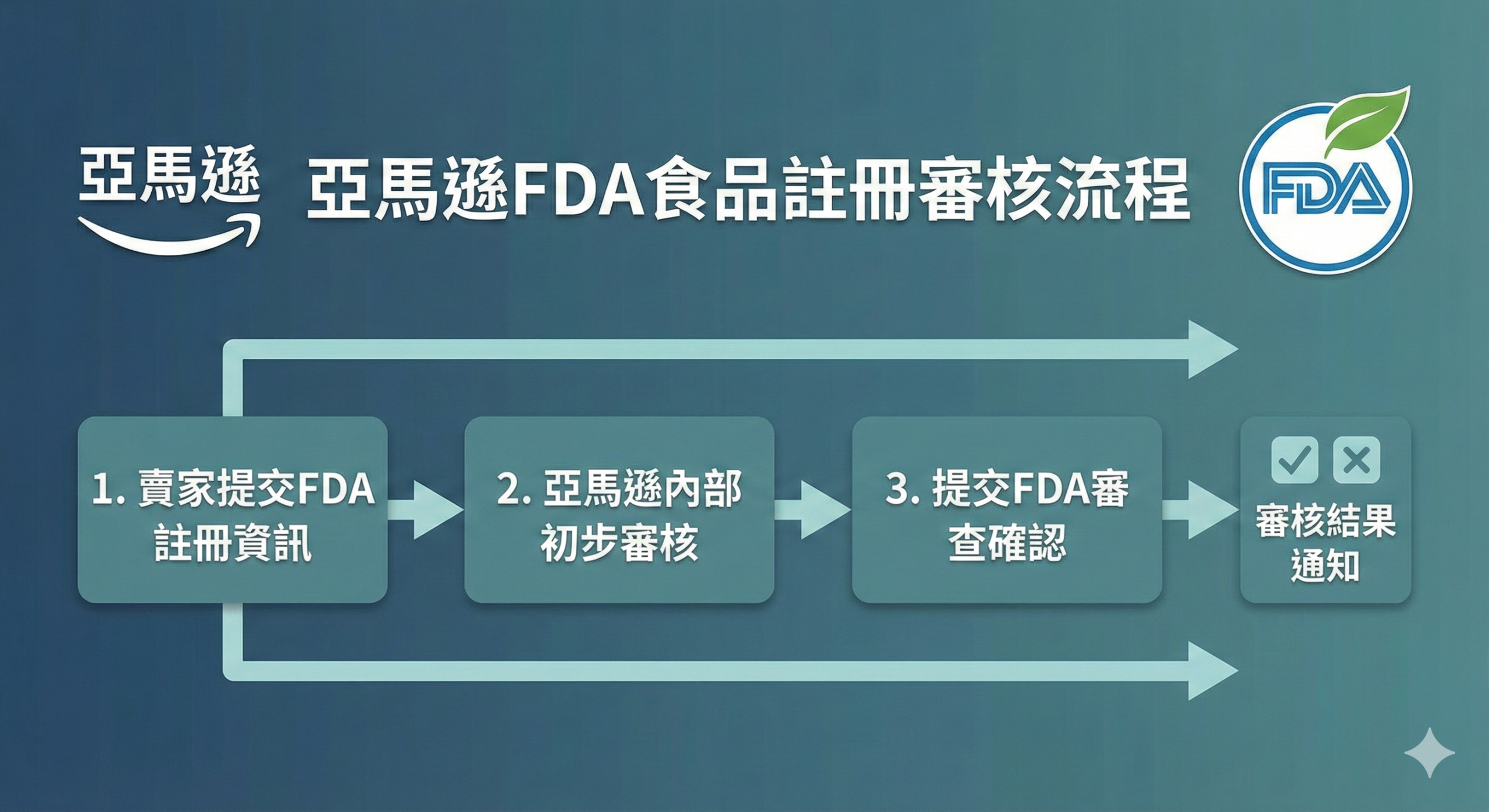
Amazon's requirement for sellers to provide an FDA food registration number is not a mandatory requirement under U.S. federal regulations, but rather an internal review mechanism set up by Amazon based on the platform's risk management. This requirement focuses on specific types of food (e.g., dietary supplements, baby food, pet food) or account risk assessment results, and is used to reduce the risk of product safety disputes and platform liability.
Institutional Background of Amazon's FDA Food Registration Requirements
As a third-party sales platform, Amazon is not obligated to require all food sellers to complete FDA food registration. However, the platform has established an internal audit mechanism based on the following three risk management considerations:
- Product Safety Liability Risks: Amazon may face consumer complaints or legal liability if a safety incident occurs with food sold on the platform.
- Account Trust Assessment: New sellers, historically non-compliant sellers, or sellers in high-risk categories may be asked to provide additional compliance documentation.
- Category Risk Level: High-risk categories such as dietary supplements, baby food, and pet food are often required to provide an FDA registration number or other proof of compliance.
This system is not designed to be a regulatory requirement, but rather an internal rule that Amazon uses to screen sellers and minimize risk to the platform.
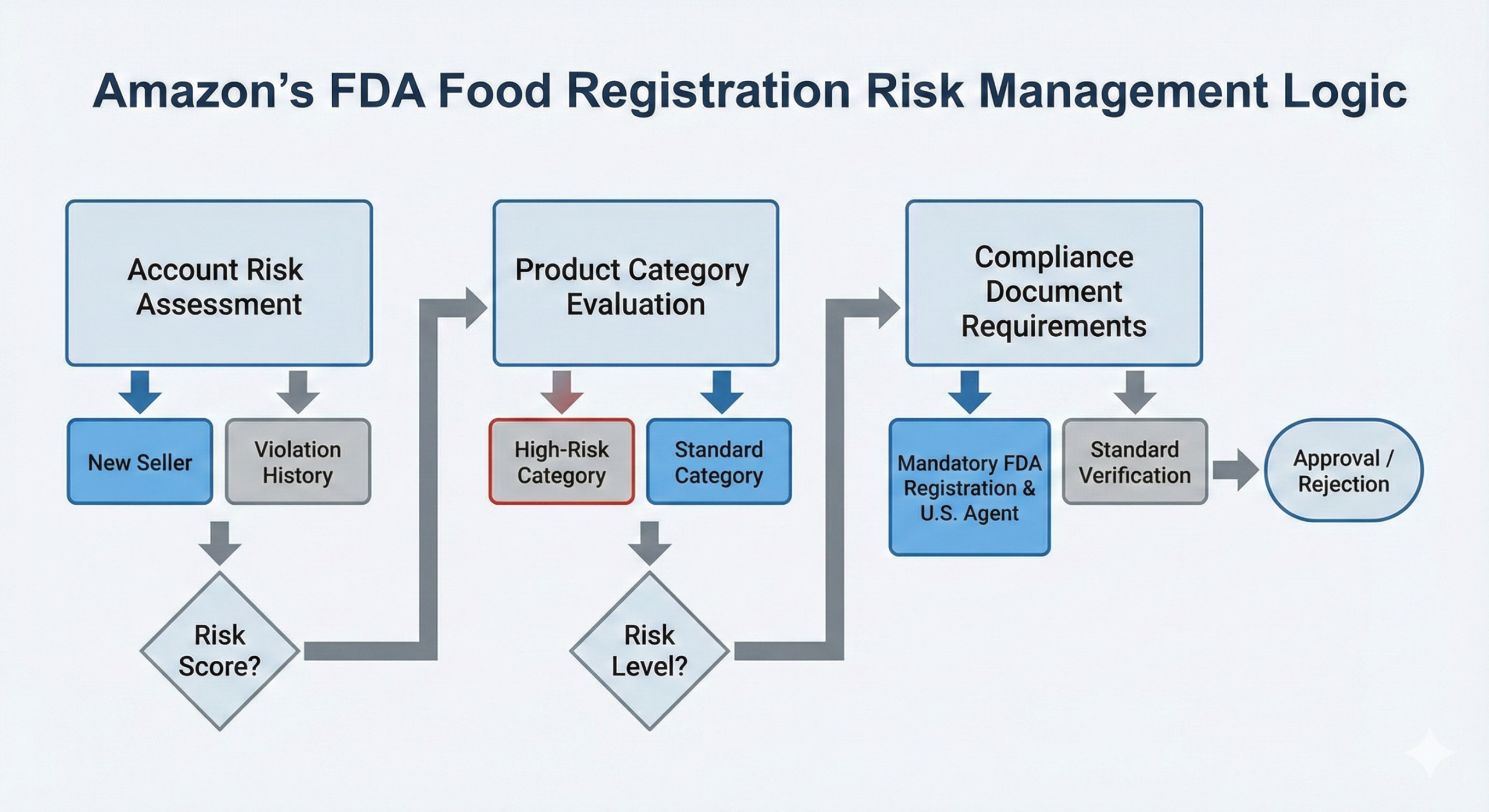
This diagram illustrates how Amazon uses a three-stage judgment process to determine whether to require sellers to provide an FDA food registration number or other compliance documentation.
Emphasis on Practical Judgment for Amazon Platform Audit Rules
Amazon's review rules are not fixed or transparent, but are dynamically adjusted based on account status, product category, and system algorithms. The following are some of the most common scenarios in practice:
Account Risk Assessment
Amazon determines whether additional review is required based on a seller's account history, sales history, and violation history. Common triggers include:
- Newly registered accounts, no sales records or appraisals yet
- Have been warned or suspended due to product safety and compliance issues.
- A large number of food items will be put on the shelves in the near future
In such cases, Amazon may require sellers to provide an FDA food registration number, product inspection report, or other compliance documentation.
Product Category Risk Level
Amazon categorizes food categories into different risk levels, with higher-risk categories often requiring more stringent scrutiny. Common high-risk categories include:
- Dietary Supplements
- Baby Food
- Pet Food
- Foods with specific ingredients (e.g. caffeine, herbal ingredients)
Sellers of these types of items may be required to provide an FDA registration number, even if there are no account violations.
System Algorithm and Random Inspection
Amazon's review system randomly checks seller accounts based on an algorithm, and even if a seller meets all the rules, they may be asked to provide additional documentation. These situations are unpredictable, and sellers can only provide documents upon request when notified.
Table Description: Amazon Platform Audit Scenarios and Key Points for Response (Compiled by: [Green Circle])
| Audit Context | Common Trigger Conditions | The platform may require | Seller's Focus |
|---|---|---|---|
| New Seller Account | No sales records, no reviews | FDA Registration Number, Product Inspection Reports | Complete FDA registration and compliance documentation in advance. |
| High Risk Categories | Dietary supplements, baby food, pet food | FDA registration number, proof of ingredient labeling | Confirm the product category and prepare the corresponding compliance documents. |
| Historical Violation Records | Has been warned or suspended for product safety issues | Additional Compliance Documents, Third Party Inspection Reports | Improve product compliance with complete documentation |
| System Random Inspection | No specific conditions, randomly triggered by the algorithm. | FDA registration number or other compliance documentation | Upon receipt of the notification, provide relevant documents as required |
Text description (placed below the form)
This table organizes the common audit scenarios and response points on the Amazon platform to help sellers quickly determine their own situation and prepare documentation to address them.
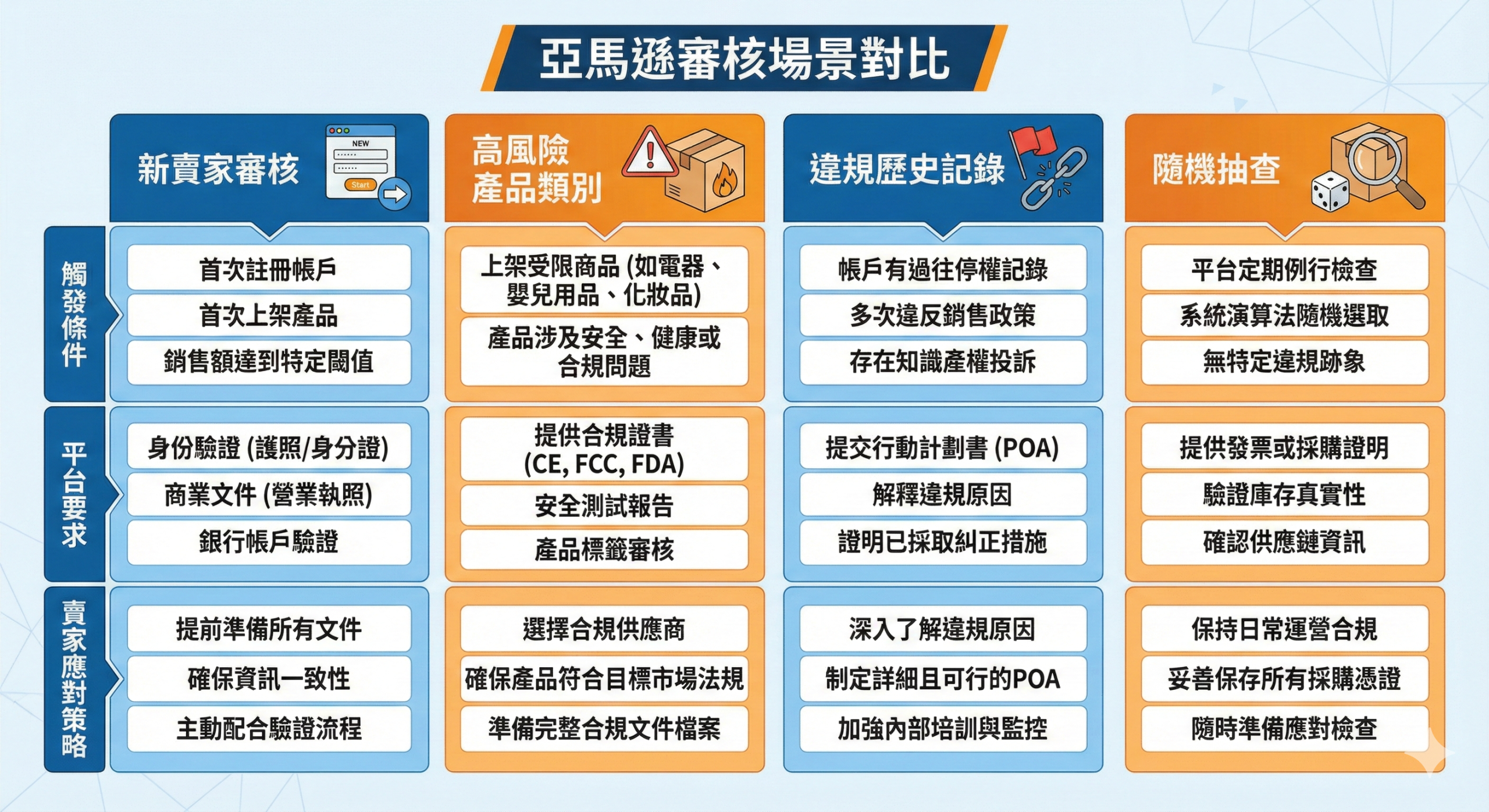
This chart illustrates the types of documents that Amazon may require and the seller's response strategy in different audit situations, to help sellers quickly determine their own situation.
Common Misconceptions and Practical Advice for Sellers
Many sellers have misconceptions about Amazon's FDA food registration requirements. Below are some common misconceptions and practical suggestions:
Misconception 1: All Foods Need FDA Registration
Amazon does not require all food sellers to complete FDA registration, only specific situations or categories of products. Sellers should check their product category and account status before deciding whether they need to complete registration.
Misconception #2: Completing FDA registration is enough to pass the audit.
FDA food registration is only one of the compliance documents, and Amazon may also require product inspection reports, ingredient labeling certificates, or other documents. Sellers should provide complete compliance documentation as notified by the platform.
Misconception 3: Audit Rules are Fixed and Public
Amazon's review rules are not fixed or transparent, but are dynamically adjusted based on account status, product category, and system algorithms. Sellers should always pay attention to the notifications on the platform and provide relevant documents upon request.
[Application Notes
The content of this article is based on the currently available public information and practical experience on the Amazon platform, and the actual review situation should be based on the latest notification and actual implementation of the Amazon platform.
According to Amazon Seller Central's public statement, the platform's requirement for sellers to provide FDA food registration numbers or other compliance documents is based on the platform's risk management and responsibility for product safety, and is not a mandatory requirement under U.S. federal regulations.
Official source:
Amazon Seller Central - Food & Beverage Product Safety
https://sellercentral.amazon.com/gp/help/external/G200164750
[FAQ
Q1:Why does Amazon require sellers to provide FDA food registration number?
Amazon requires sellers in certain situations or categories to provide an FDA food registration number due to platform risk management and product safety responsibilities, and is not a mandatory requirement under U.S. federal regulations.
Q2: Do all food sellers need to complete FDA registration?
Amazon requires sellers to provide an FDA registration number or other compliance documentation only for specific situations (e.g., new sellers, high-risk categories, historical violations) or for random system checks.
Q3: After completing FDA registration, can I be reviewed by Amazon?
Amazon may also require product inspection reports, ingredient labeling certificates, or other compliance documents, and sellers should provide complete documentation as notified by the platform.
Q4:Amazon's review rules are fixed and public?
No. Amazon's review rules are dynamic, based on account status, product category, and system algorithms, and are not fixed or transparent.
Q5:What should I do after receiving an Amazon audit notice?
Sellers should provide FDA registration numbers or other compliance documents and confirm product category and account status as required by Platform notifications to minimize audit risk.
If you have not yet developed an overall understanding of FDA's food registration system, it is recommended that you start with a complete overview to help you later determine the different contexts and implementation differences.
👉 FDA Food Registration Guide|Taiwan Food Exports to U.S.A. Must Read (2026 Update)
https://greenoo.tw/fda-food-registration/
For further information on the FDA food registration application process and required documents, please refer to the following pages to clarify practical points of judgment.
👉 FDA Food Registration Process and Documentation|Taiwan Application Highlights (2026)
https://greenoo.tw/fda-food-registration/fda-food-registration-process-and-documents-taiwan/
For further information on FDA food registration holds, inspections, and common errors, please refer to the following pages to clarify practical points of judgment.
👉 FDA Food Registration Risk Analysis|Detention, Inspection and Common Errors (2026)
https://greenoo.tw/fda-food-registration/fda-food-registration-risks-and-inspections/
[CTA at end of article]
Before planning, it is recommended to establish a proper understanding of the overall system and logic of judgment, and then conduct an assessment based on your own conditions, which will help reduce the uncertainty of subsequent decision-making and implementation.
For a systematic understanding of this topic, please refer to [Green Circle] A complete description of what has been organized.
[Description
This article is intended to be informative and is intended to assist in the understanding of the system and the logic of judgment, and does not constitute legal, regulatory or operational advice.
 EN
EN  ZH_TW
ZH_TW  ZH
ZH