
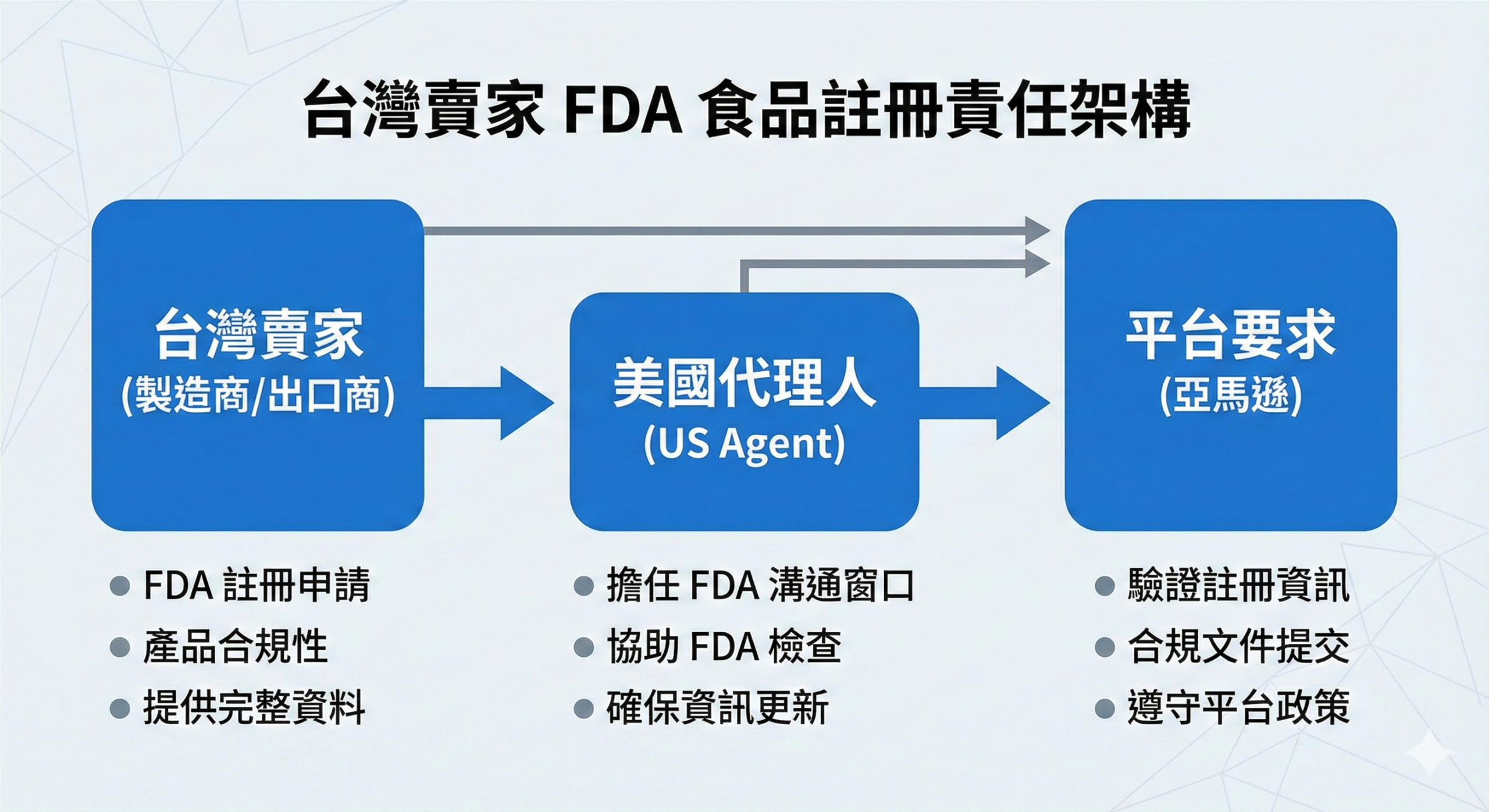
Sellers in Taiwan are subject to the FDA's food registration obligations as "manufacturers or exporters," and even if they sell through an agent or platform, they must ensure that their registration information is correct, up-to-date, and in compliance with the FDA's regulations. Platforms (such as Amazon) may require sellers to provide proof of registration, but platform requirements do not equate to regulatory liability, which remains subject to FDA regulations.
FDA's Responsible Subject Matter Determination for Food Registration
Under FDA regulations, all manufacturers, processors, or packagers that import food into the United States are required to complete a Food Facility Registration (FFR). For Taiwan sellers, the responsible entity is usually the "business that actually manufactured or exported the food," not a middleman or platform.
Even when exporting through an agent or third-party logistics (3PL), Taiwan sellers must ensure that the registration information is correct and up-to-date. In the event of a product recall, seizure, or inspection issue, the FDA will directly trace the responsible entity in the registration information, not the agent or platform.
Common Misconceptions of Responsibility among Taiwanese Sellers
Many Taiwanese sellers mistakenly believe that they are not responsible for the registration process as long as it is handled by an agent or a platform, which is the most common misconception. This is the most common misconception. In fact, agents or platforms can only assist in the registration process, but they cannot replace the seller's legal responsibility.
Another common misconception is that "one registration is good for life. "FDA food facility registrations need to be renewed every two years (October 1 through December 31 of even-numbered years), and failure to do so may result in the inability to import or the seizure of the product.
In addition, some sellers believe that "only large enterprises need to register", but in fact, as long as the product enters the U.S. market, regardless of the size of the enterprise or the number of exports, registration must be completed.
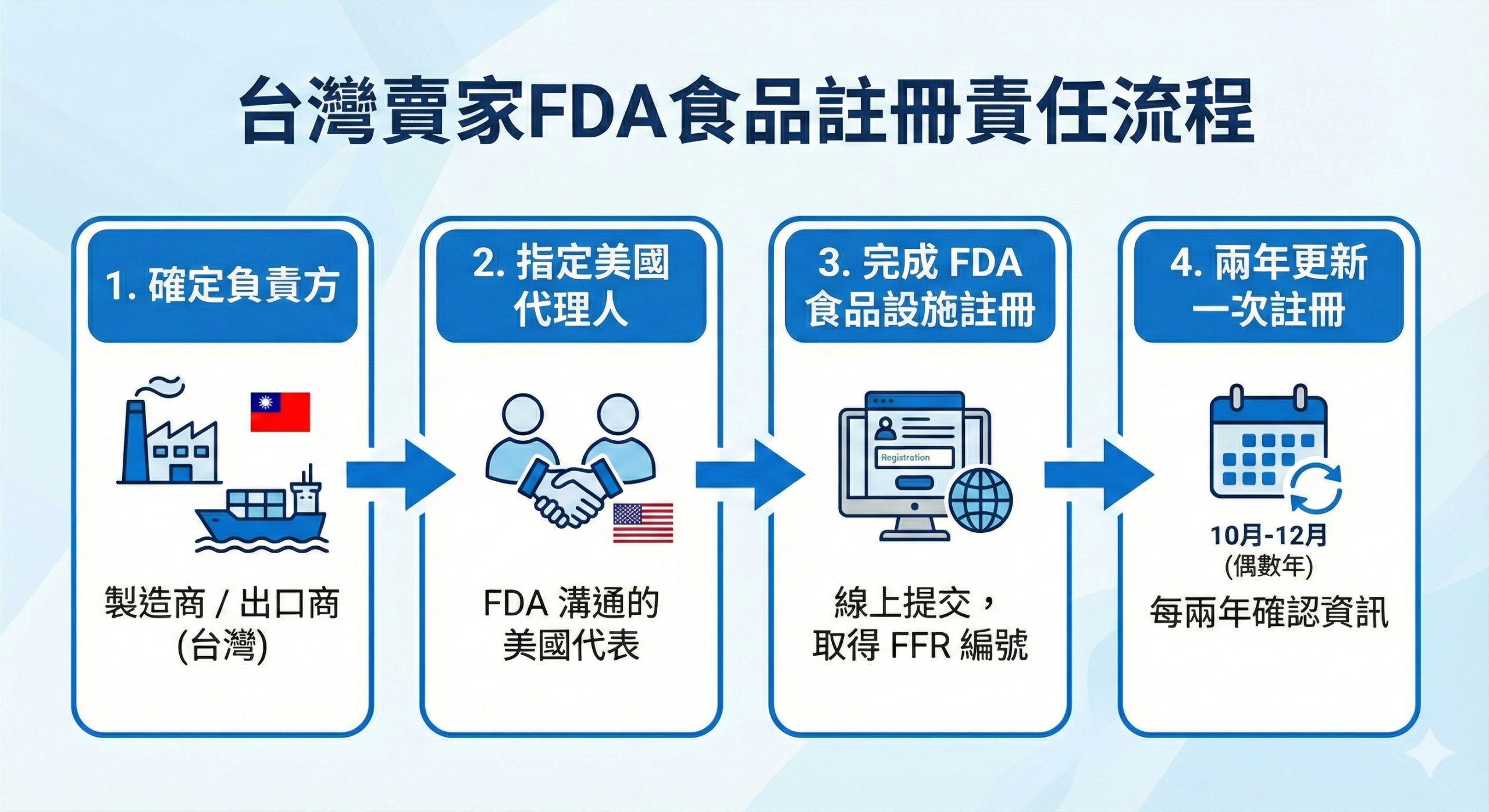
(This diagram illustrates the process of determining the responsibilities of Taiwanese sellers in FDA food registration, and assists in understanding the division of labor and boundaries of responsibilities among different roles.)
The Role and Boundaries of Responsibility of a U.S. Agent (US Agent)
The US Agent is a necessary role in the registration of FDA food facilities, but its responsibilities are limited to "acting as a window of communication between the FDA and Taiwanese sellers" and is not a bearer of regulatory responsibilities.
In practice, the U.S. agent is a person or business within the U.S. that is responsible for receiving notices, requests for inspections, or emergency contacts from the FDA. However, in the event of a product problem or violation, the FDA will still go directly to the "responsible entity" in the registration information, i.e., the Taiwanese seller itself.
Therefore, when choosing a U.S. agent, it is important to check the validity and timeliness of their contact information to avoid delays in inspection or recall notification due to inability to contact the agent.
Differences Between Platform Requirements and FDA Regulatory Obligations
E-commerce platforms, such as Amazon, may require sellers to provide an FDA food facility registration as part of their on-shelf review. However, the platform requirement is only a "commercial review standard" and is not a regulatory obligation of the FDA.
In practice, even if the Platform does not require proof of registration, Taiwanese sellers are still required to complete registration in accordance with the FDA requirements. On the other hand, if the platform requires proof of registration but the seller does not actually comply with the FDA registration conditions (e.g., the product type is not applicable), the FDA requirements should prevail instead of blindly cooperating with the platform's requirements.
In addition, the platform's approval does not mean that it is FDA-compliant, and sellers are still required to verify that their products comply with the FDA Food Safety Modernization Act (FSMA), labeling regulations, and other relevant requirements.
Form InstructionsTaiwan Seller FDA Food Registration Liability Judgment Table (Compiled by: [Green Circle])
| character | Scope of Responsibility | Common Misconceptions | Practical Recommendations |
|---|---|---|---|
| Taiwan Seller (Manufacturer/Exporter) | Complete registration, ensure information is correct, and update regularly. | Misunderstanding that an agent is a substitute for responsibility | Confirmation of registration status, do not rely solely on the agent |
| US Agent | Serves as the FDA contact window | Misunderstanding that an agent is liable under the law | Confirm the validity of agent contact information |
| E-commerce platforms (e.g. Amazon) | Request for proof of registration (commercial audit) | Mistakenly believing that platform audits are equivalent to FDA compliance | Be FDA compliant, not blindly aligned with platforms |
| FDA | Enforcement of inspection, seizure and recall | Misunderstanding that the FDA proactively reminds of updates | Track your own renewal deadlines to avoid being late |
Text description (placed below the form)::
(This table organizes the attribution of responsibilities and common misconceptions of Taiwanese sellers in FDA food registration to help quickly determine the boundaries of responsibilities and practical priorities of different roles.)
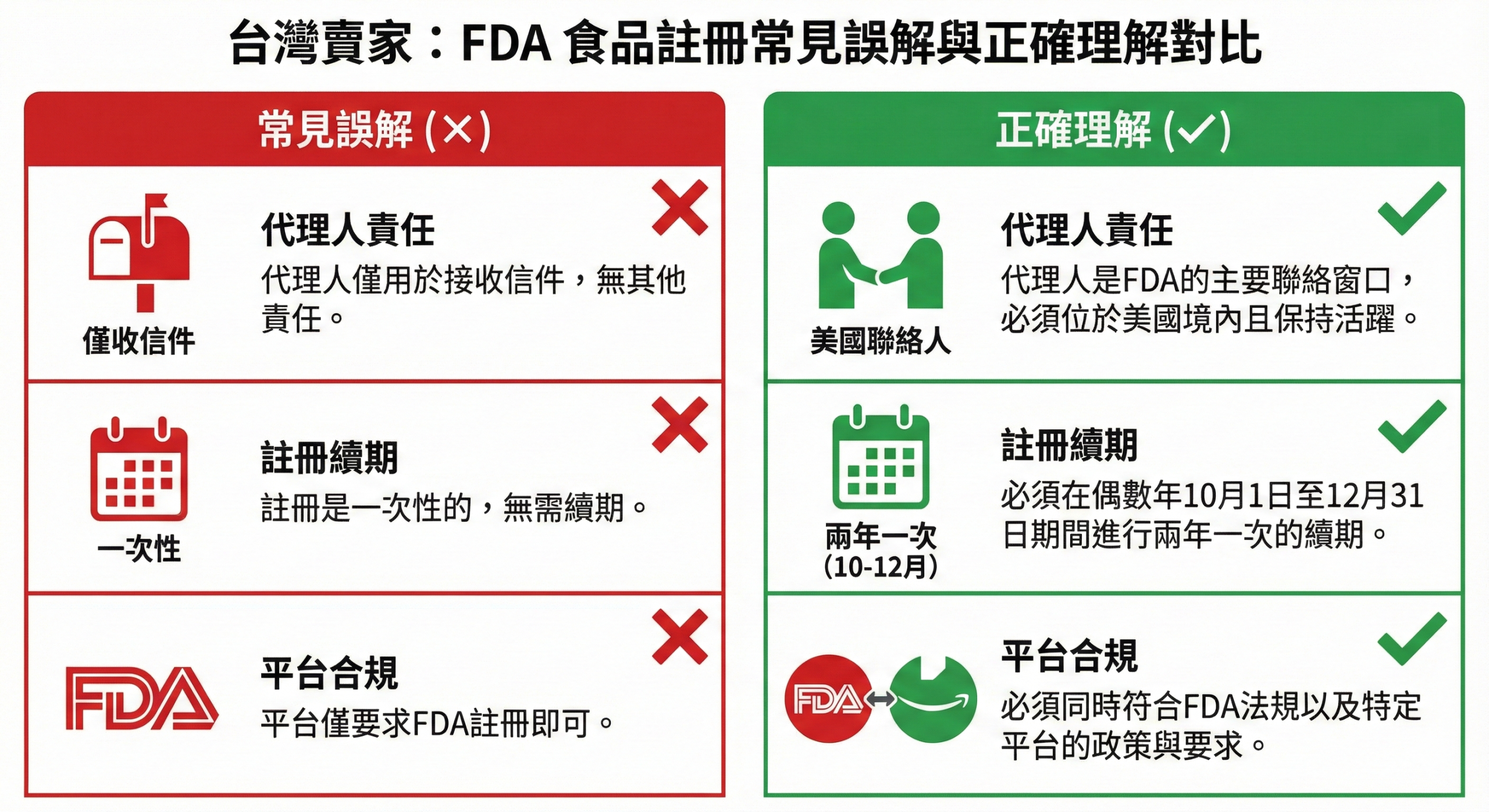
(This chart compares the common misconceptions and correct judgments of Taiwanese sellers in FDA food registration, and helps clarify the practical attribution of responsibility and compliance points.)
Practical Responsibility Checkpoints for Taiwanese Sellers
After completing the FDA food facility registration, Taiwanese sellers should periodically check the following to ensure continued compliance with FDA regulations:
- Is the registration information correct?Includes business name, address, contact information, product type, etc., and must be updated in a timely manner if there are any changes.
- Validity of U.S. Agent Contact Information: Ensure that your agent receives FDA notifications properly to avoid delays in processing due to lack of contact.
- Whether the registration renewal period is tracked: Updates need to be completed every two years from October 1 to December 31 of even-numbered years, and it is recommended that a reminder be set in advance.
- Whether the product type is within the scope of registration: If there is a change or addition of a product type, it is necessary to confirm whether the original registration information is still applicable.
In the event of a product recall, seizure, or inspection, Taiwan sellers should proactively cooperate with FDA's request to provide relevant documents and instructions to avoid increasing risks due to delays in processing.
[Application Notes
The content of this article is based on currently available official information, the actual application of the latest announcements of the competent authorities and the actual implementation shall prevail.
[Official Supporting Documents
According to FDA's public instructions, all manufacturers, processors, or packers who import food into the United States are required to complete a food facility registration, which must be updated every two years. The responsible entity is the actual manufacturer or exporter of the food product, even if it is sold through an agent or platform, and the registration information must be correct and current.
Official source:
Food Facility Registration
https://www.fda.gov/food/food-safety-modernization-act-fsma/food-facility-registration
If you have not yet developed an overall understanding of FDA's food registration system, it is recommended that you start with a complete overview to help you later determine the different contexts and implementation differences.
👉 FDA Food Registration Guide|Taiwan Food Exports to U.S.A. Must Read (2026 Update)
https://greenoo.tw/fda-food-registration/
For further information on the FDA food registration application process and required documents, please refer to the following pages to clarify practical points of judgment.
👉 FDA Food Registration Process and Documentation|Taiwan Application Highlights (2026)
https://greenoo.tw/fda-food-registration/fda-food-registration-process-and-documents-taiwan/
For further information on FDA food registration holds, inspections, and common errors, please refer to the following pages to clarify practical points of judgment.
👉 FDA Food Registration Risk Analysis|Detention, Inspection and Common Errors (2026)
https://greenoo.tw/fda-food-registration/fda-food-registration-risks-and-inspections/
FAQ
Q1:Who is the responsible entity for Taiwan sellers in FDA food registration?
The responsible entity is the Taiwan enterprise that actually manufactures or exports the food product. Even if the food product is sold through agents or platforms, it is still necessary to ensure that the registration information is correct and updated in a timely manner.
Q2: Can a US agent take over the legal responsibility of a Taiwan seller?
No. A U.S. agent acts only as a liaison between FDA and the Taiwan seller and cannot replace the seller's regulatory responsibilities.
Q3: Does a platform (e.g. Amazon) requiring proof of FDA registration equate to FDA compliance?
Not equivalent. Platform requirements are for business review only. Actual liability is subject to FDA regulations, and sellers are responsible for confirming compliance with FDA regulations.
Q4: How often does FDA food facility registration need to be renewed?
Updates are required every two years, from October 1 to December 31 of even-numbered years.
Q5:What are the risks if a Taiwan seller fails to update his/her registration information in time?
It may result in the product not being imported, being seized, or facing FDA inspection, and in the event of a product problem, it will be traced directly to the responsible party in the registration information.
Q6:How can Taiwanese sellers confirm their FDA food facility registration status?
You can check the status of your registration through the FDA's official system or contact your U.S. agent to confirm that the registration information is correct and valid.
Q7:Do I need to re-register if the product type changes?
Subject to change. If the product type is still within the original registration scope, only the registration information needs to be updated; if it is outside the scope, the applicability of the registration needs to be reassessed.
[Description
This article is for informational purposes only and is intended to assist in the understanding of the system and the logic of judgment, and does not constitute legal, regulatory or operational advice.
End of article CTA
Before planning, it is recommended to establish a proper understanding of the overall system and logic of judgment, and then conduct an assessment based on your own conditions, which will help reduce the uncertainty of subsequent decision-making and implementation.
For a systematic understanding of this topic, please refer to [Green Circle] A complete description of what has been organized.
 EN
EN  ZH_TW
ZH_TW  ZH
ZH