
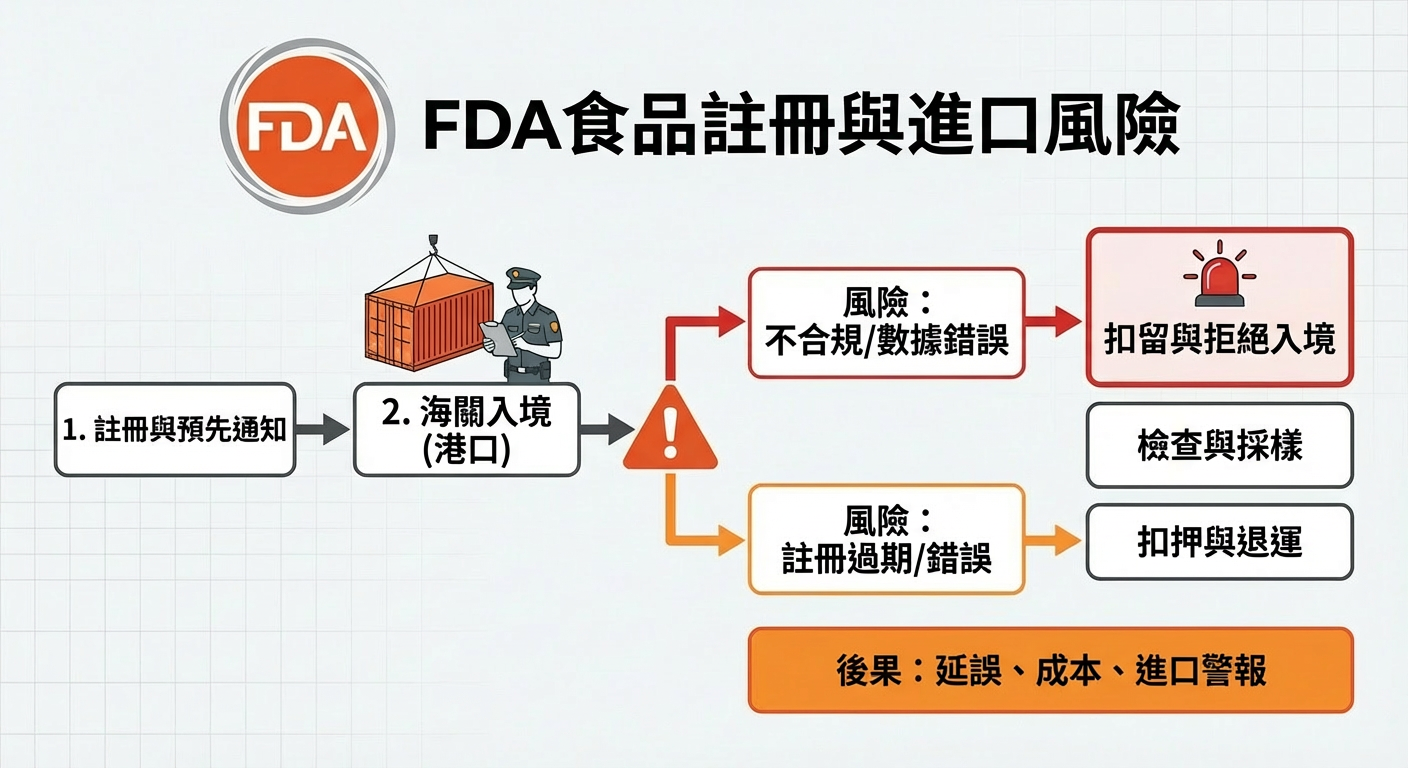
After the completion of FDA food registration, the product may still be subject to customs clearance or inspection due to inconsistencies in product labeling, ingredient declaration, facility registration information, etc. The main risks are centered on the correctness of the documents, labeling compliance, and the obligation of subsequent updates.
I. Types of Risks That May Still Be Encountered After FDA Food Registration
FDA food registration is not a one-time, long-term process, but rather a compliance obligation that requires ongoing maintenance and updating. Even after registration is complete, you may still be subject to seizure or inspection under the following circumstances:
1. Inconsistency between the product labeling and the declared content.
If the composition, packaging or labeling of the actual exported product does not match with the information provided during the initial registration, the Customs and Excise Department may directly detain the product and request for additional explanation.
2. Facility login information is out of date or not updated.
The FDA requires food facilities to undergo a Biennial Registration Renewal every two years, and if this is not done by the deadline, products produced at the facility may be considered non-compliant.
3. product category misjudgment
Some of the products may involve food, dietary supplements or pharmaceutical products at the same time. If the registered category does not match with the actual product attributes, it may trigger inspection or require re-declaration.
Common Deduction Contexts and Logic of Judgment
Detention is a temporary, not final, action taken by FDA on a suspected noncompliant product. Below are some common scenarios of detentions in practice:
Scenario 1: Labeling does not comply with FDA regulations
Incorrect formatting of nutrition labels, failure to label allergens, incorrect ordering of ingredients, etc. may lead to customs clearance.
Scenario 2: The product ingredient involves prohibited or restricted substances
For example, certain botanical extracts, additives, or colors may be required to provide additional documentation at the time of inspection if compliance with the FDA-approved list is not confirmed in advance.
Scenario 3: Facility registration number does not match
If the Facility Registration Number (FFR Number) on the export document does not match the FDA system information, Customs may not be able to release the document.
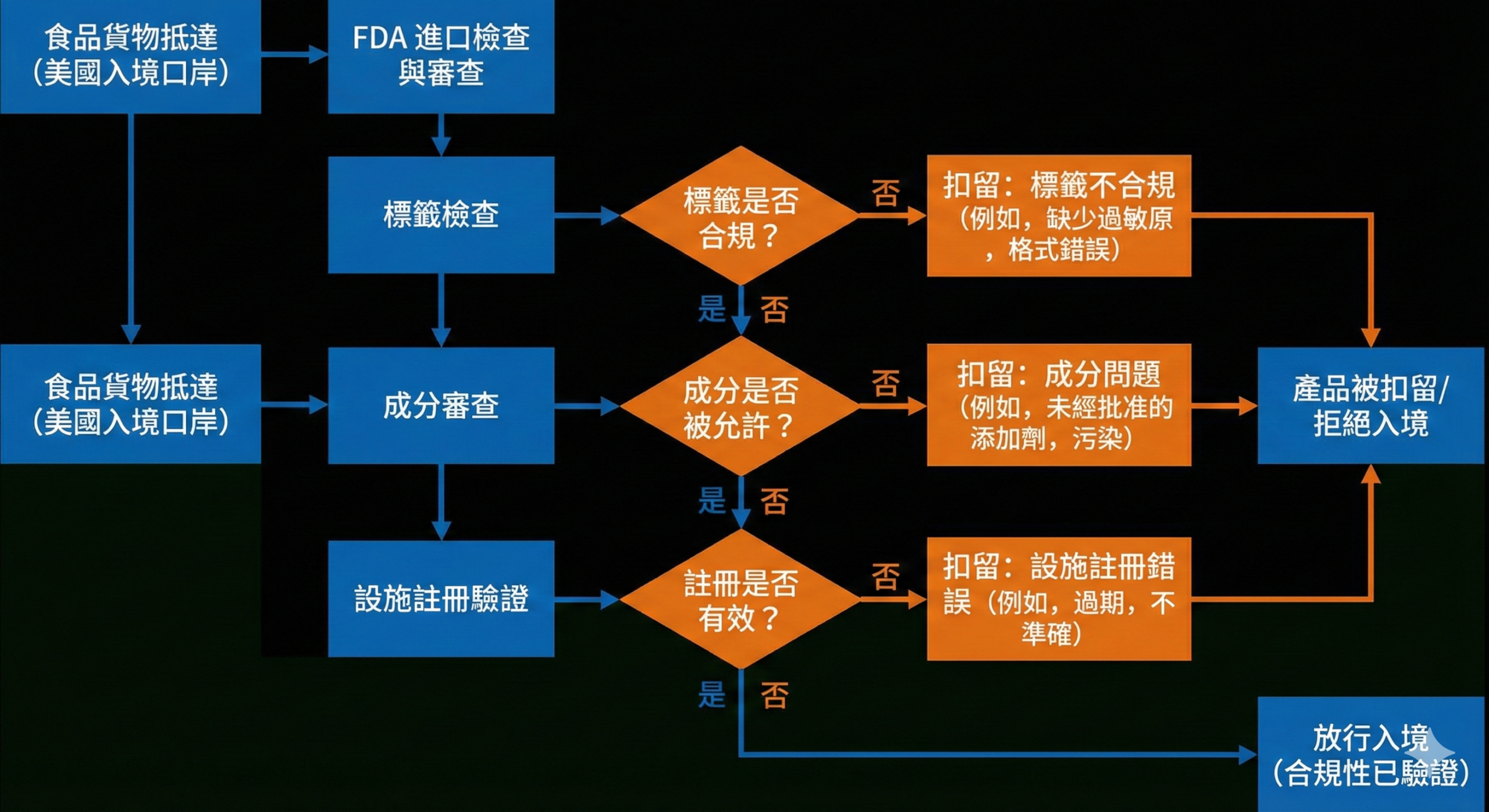
This chart illustrates the three most common reasons for FDA food seizures and the process for determining them to help understand where the risk is concentrated.
Inspection and Field Audit Possibilities
In addition to seizures, FDA may also conduct on-site inspections or document audits of registered food facilities to confirm continued compliance.
Check Type I: Document Review
FDA may require production records, proof of ingredient origin, quality control documents, etc. to confirm that the product complies with the declaration.
Inspection Type II: On-site Inspection
If the product is in a high-risk category (e.g., aquatic products, canned foods), FDA may send an agent to the manufacturing facility to conduct an on-site inspection to verify that the manufacturing environment and processes are in compliance with HACCP or other mandatory requirements.
Inspection Type III: Import Alert
If the same facility or product type has been detained or failed multiple times, FDA may place it on an Import Alert List, and all subsequent related products will require additional inspection before release.
Description of the form: FDA Food Registration Risk Scenario Judgment Table (Compilation: [green circle])
| Risk context | Possible causes | Scope of Impact | Suggested Approach |
|---|---|---|---|
| Detention | Labeling discrepancies, ingredient concerns, facility information errors | Single shipment cannot be released at the moment | Supplementary Explanatory Notes or Re-declaration with Amendments |
| Document Review | FDA requires manufacturing records or proof of ingredients. | Specific products or batches | Prepare complete documents and meet deadlines |
| On-site Inspection | High-risk products may have a history of non-compliance | Entire Production Facility | Ensure that production environments and processes are HACCP compliant. |
| Import Alert | Multiple non-compliance for the same facility or product | All products related to the facility | Propose an improvement plan and apply for removal of the alerts |
This table organizes the risk scenarios and judgment points that may be encountered with FDA food registrations to assist in quickly understanding the scope of the impact of different situations and how to handle them.
Common Mistakes and Practical Misconceptions
In practice, many Taiwanese food manufacturers have the following misconceptions about the risk of FDA food registration:
Misconception 1: Thinking that registration is complete will not be suspended
Registration only means that the facility and product have been incorporated into the FDA system, but the actual export of the product must still ensure that the product labeling and ingredient declarations are consistent with the registration information.
Misunderstanding 2: Thinking that all products are subject to the same set of regulations
Different product categories (e.g. general food, dietary supplements, low-acid canned food) are subject to different regulations and cannot be generalized.
Misconception 3: Thinking that facility registration is permanent
The FDA requires facility registrations to be renewed every two years, and if the deadline is not met, products produced at the facility may be considered non-compliant.
Misconception 4: Thinking that Customs Arrest Means Import Prohibition
The hold is only a temporary measure, and there is still a chance of release if the documents can be replaced or corrected in time.
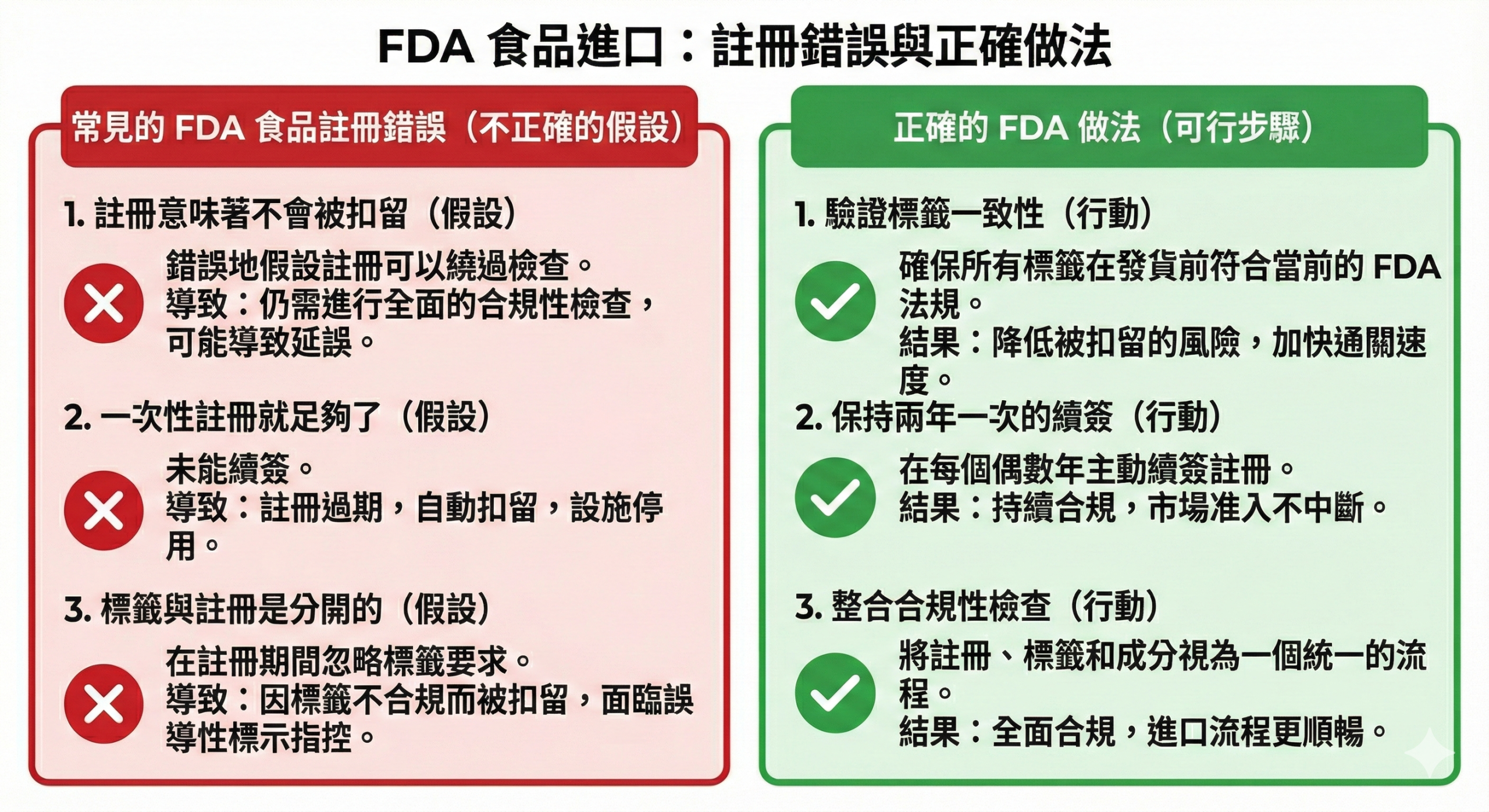
This chart compares common errors and correct practices in FDA food registration to help understand the key points of practical judgment.
V. How to Reduce the Risk of Customs Detention and Inspection
Based on the above risk scenarios and common mistakes, the following are practical risk management measures that can be taken:
Measure 1: Establishment of a mechanism for checking the consistency between labeling and declaration
Before each export, you should reconfirm whether the content of the product label is the same as the information provided during the initial registration to avoid customs clearance deduction due to information discrepancies.
Measure 2: Regularly Update Facility Login Information
Setting up a reminder mechanism to ensure that the registration and update of the facility is completed every two years to avoid affecting the release of products due to expiry.
Measure 3: Pre-verify that product ingredients meet FDA regulations
If the product involves new ingredients or special additives, you should check the FDA approved list or consult a professional organization beforehand to avoid the inspection due to ingredient concerns.
Measure 4: Keep complete production and quality management records
In the event of a documented audit or on-site inspection, complete production records and quality management documentation can speed up the review process and reduce the risk of non-compliance.
[Official Rationale]
According to the FDA's official public information, food facility registration must be renewed every two years (Biennial Registration Renewal), and the actual exported products must comply with the contents of the original registration declaration, otherwise, they may be subject to customs clearance or inspection.
official source::
FDA Food Facility Registration
https://www.fda.gov/food/food-facility-registration
[Application Note]
The content of this article is based on currently available official information, the actual application of the latest announcements and actual implementation of the competent authorities shall prevail.
[FAQ
Q1:Will I still be detained after the FDA food registration is completed?
The Association. Even after registration, if the product labeling, ingredient declaration or facility registration information is not consistent with the actual export content, you may still be subject to customs clearance.
Q2: Under what circumstances will I be subject to an FDA field audit?
If a product is in a high-risk category (e.g., aquatic products, canned foods) or has a history of noncompliance, FDA may send an agent to the manufacturing facility to conduct an on-site inspection.
Q3: Is the facility registration permanent?
No. FDA requires food facilities to undergo a Biennial Registration Renewal every two years, and products produced in the facility may be considered non-compliant if the deadline is not met.
Q4: Is there any chance of release after detention?
Yes. The hold is only a temporary measure. If the documents can be replaced or corrected in time, there is still a chance of release.
Q5: How to reduce the risk of being put on the Import Alert List?
A mechanism should be established to check the consistency of labeling and reporting, regularly update the facility registration, confirm in advance whether the product ingredients are in compliance with FDA regulations, and keep complete production and quality management records.
Q6:What documents will be required by FDA for inspection?
This may include production records, certificates of origin of ingredients, quality management documents, HACCP plans (if applicable), etc.
Q7:How can I confirm that my product complies with the FDA labeling requirements?
Refer to the Labeling Guide published by the FDA or consult a professional compliance organization for confirmation.
If you have not yet developed an overall understanding of FDA's food registration system, it is recommended that you start with a complete overview to help you later determine the different contexts and implementation differences.
👉 FDA Food Registration Guide|Taiwan Food Exports to U.S.A. Must Read (2026 Update)
https://greenoo.tw/fda-food-registration/
For further information on the FDA food registration application process and required documents, please refer to the following pages to clarify practical points of judgment.
👉 FDA Food Registration Process and Documentation|Taiwan Application Highlights (2026)
https://greenoo.tw/fda-food-registration/fda-food-registration-process-and-documents-taiwan/
Before planning, it is recommended to establish a proper understanding of the overall system and logic of judgment, and then conduct an assessment based on your own conditions, which will help reduce the uncertainty of subsequent decision-making and implementation.
For a more systematic understanding of this topic, please refer to the full description organized by [Green Circle].
[Description of contents]
This article is intended to be informative and is intended to assist in the understanding of the system and the logic of judgment, and does not constitute legal, regulatory or operational advice.
 EN
EN  ZH_TW
ZH_TW  ZH
ZH