
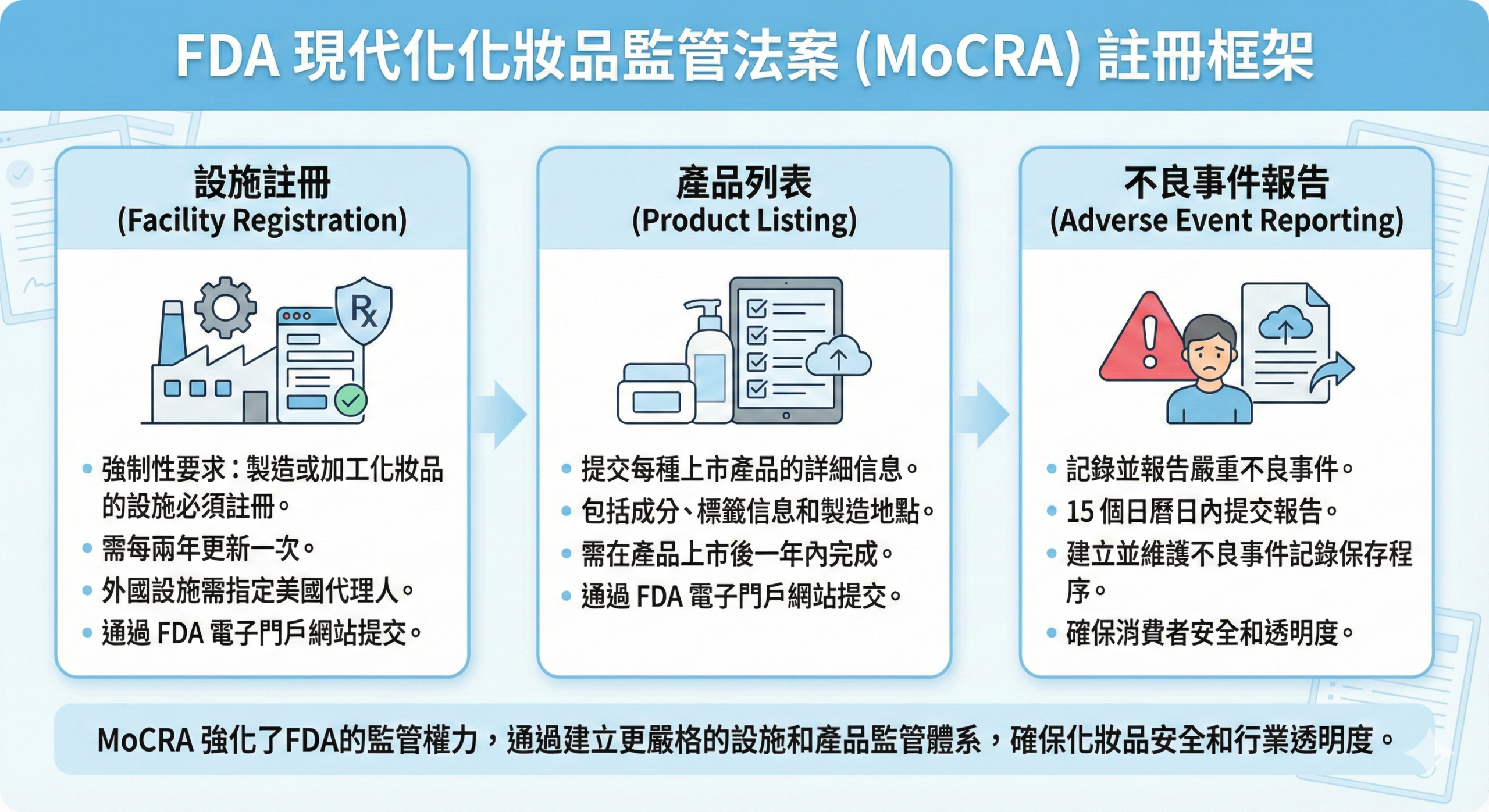
The MoCRA (Modernization of Cosmetics Regulation Act of 2022), signed into law by the President of the United States on December 29, 2022, brings the most significant changes to the FDA's cosmetics regulatory system in nearly 80 years. The Act requires cosmetic manufacturers and brand owners to maintain facility registration and product listing, as well as adverse event notification and safety data retention, and applies to all parties responsible for selling cosmetic products in the U.S., regardless of whether the products are of domestic or imported origin.
(This chart organizes the core structure of the FDA's cosmetics registration system after the implementation of MoCRA to assist in understanding the three major axes of facility registration, product listing, and adverse event notification.)
Legislative Background and Scope of the MoCRA Statute
The passage of MoCRA stems from the U.S. Congress's reflection on the lack of a mandatory regulatory mechanism for the cosmetics industry. Previously, the FDA's authority to regulate cosmetics was quite limited, as it was unable to require product registration or ingredient declarations, and could only intervene passively through market surveillance and consumer complaints after a product was released on the market.
To whom the statute applies
The following entities are subject to registration and reporting obligations under MoCRA:
- Manufacturer: A facility that actually formulates, processes, or packages a product.
- Responsible Person: A legal or natural person who is ultimately responsible for the safety and compliance of the product.
- Importer: The entity that brings cosmetics into the U.S. for domestic sale.
Products sold in the U.S. market are subject to MoCRA requirements regardless of whether they are manufactured in the U.S. or imported from abroad.
exemptions
The MoCRA statute provides partial exemptions for the following situations:
- Small Businesses with annual turnover below a specified threshold
- Products sold only within a single state and not transported across state lines
- Products used internally by professional salons and not for retail sale to the public
Actual eligibility for exemptions should be determined based on the most current standards announced by the FDA and should not be assumed to apply.
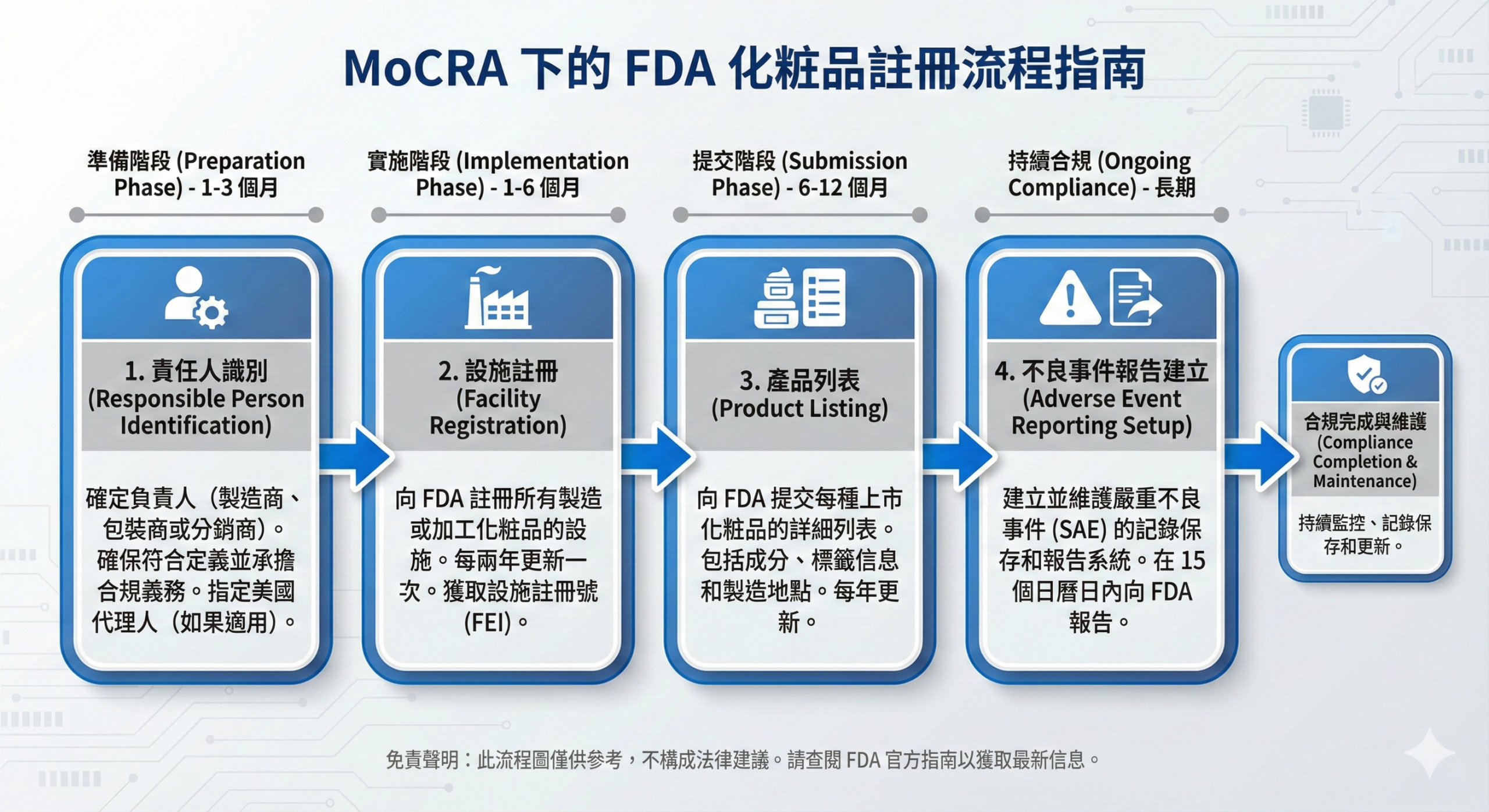
(This diagram illustrates the complete process of FDA cosmetics registration under MoCRA, including the four steps of identification, facility registration, product listing, and adverse event notification.)
Core Requirements for Facility Registration
Facility registration is a primary obligation under MoCRA, and all facilities that manufacture, process or package cosmetics are required to register with FDA and obtain a Facility Registration Number.
Registration Time Requirements
- New Facilities: Registration must be completed prior to commencement of operations.
- Existing Facilities: Registration to be completed within a specified period after the effective date of the MoCRA regulations.
- Annual Update: Registration information must be confirmed or updated annually within a specified period of time.
Registration Information
The following information is required for facility registration:
- Facility name, address and contact information
- Facility Contact Information
- Type of facility (manufacturing, packaging, processing, etc.)
- Product Type (Cosmetic Category)
Any changes to the registration information must be updated within 60 days of the change.
Logic of Product Listing
Product listing is an extension of facility registration that requires a responsible party to report every cosmetic product sold in the U.S. market.
Product list declaration content
- Product Name and Brand: Includes product name and brand labeling.
- Product Category: Select the applicable category according to the FDA classification system.
- Ingredient list: a complete list of ingredients (as named by INCI) is required.
- Responsible Party Information: Includes name, address and contact information.
- Manufacturing Facility:** Associated to a registered facility number
Product List Update Obligation
- New products: Listing requirements to be completed prior to listing
- Formulation Changes: If there are material changes to the ingredients or formulation, the listing information needs to be updated.
- Discontinued: Notify FDA and update status if product is discontinued.
📊 Form Note: FDA Cosmetics Registration Obligations vs. Timing Nodes (Compendium: Cross-Border Security Determinations - Green Circle)
| Volunteer Programs | Applicable to | Execution time | Update Frequency |
|---|---|---|---|
| Facility Registration | Manufacturers, Processors, Packagers | Prior to operation or within a specified period after the commencement of the statute | Updated annually upon confirmation or change |
| Product List | responsible party | Pre-launch | Updates when formulas are changed or discontinued |
| Adverse Event Notification | responsible party | Within 15 days of receipt of serious adverse event | Each time an event occurs |
| Security Data Retention | responsible party | Product Launch Period | Keep until 3 years after the product is discontinued |
(This table organizes the core obligations and timing requirements for FDA cosmetics registration under MoCRA to assist in determining priorities for implementation in different situations.)
Adverse Event Reporting (AER) mechanism
MoCRA regulations require responsible parties to establish an adverse event notification mechanism and submit a report to the FDA within 15 days of receiving a Serious Adverse Event.
Definition of Serious Adverse Events
Serious adverse events, as defined by the FDA, include:
- Resulting in death
- Resulting in hospitalization or prolonged hospitalization
- Causes permanent injury or loss of function
- Causes congenital defects or malformations
- Medical intervention is required to prevent the above
Notification Obligations and Responsibilities
- Notifying Body: Responsible Person
- Notification time: within 15 days of receipt of incident information
- Notification: description of the incident, product information, consumer information (can be anonymized), follow-up actions
The notification obligation is not waived because the product has been discontinued or the formulation has been changed.
Safety Substantiation Requirements
MoCRA regulations require responsible parties to maintain information sufficient to demonstrate the safety of their products and to make it available to FDA upon request.
Scope of Safety Information
- Ingredient safety evaluation: including toxicology data, skin irritation test, allergy test, etc.
- Formulation stability test: to prove the stability of the product during the shelf life.
- Microbiological testing: to certify that the product meets microbiological safety standards
- Safety of use assessment: Includes consumer use scenarios and risk assessment.
Data Retention Period
- Product Launch Period: Continuous Preservation
- After product withdrawal: at least 3 years
[Application Notes
The content of this article is based on currently available official information, the actual application of the latest announcements of the competent authorities and the actual implementation shall prevail.
[Official Supporting Documents
According to the FDA's public statement, the MoCRA regulation brings mandatory registration and reporting obligations to the U.S. cosmetics regulatory system and gives the FDA greater enforcement authority, including mandatory recalls, facility inspections, and marketing bans.
Official source:
- Modernization of Cosmetics Regulation Act of 2022 (MoCRA)
https://www.fda.gov/cosmetics/cosmetics-laws-regulations/modernization-cosmetics-regulation-act-2022-mocra - Cosmetic Facility Registration and Product Listing
https://www.fda.gov/cosmetics/registration-listing-cosmetic-product-facilities-and-products
[FAQ
Q1: Do all cosmetics sold in the U.S. need to be registered with the FDA?
Yes, under MoCRA, all cosmetics sold in the U.S., whether locally manufactured or imported, are required to complete a facility registration and product listing unless they qualify for a small business exemption or other specific exemption.
Q2:What is the execution sequence of facility registration and product listing?
You need to register your facility and obtain a facility number before making a product list declaration, as the product list needs to be linked to the registered facility.
Q3:Do I need to re-declare the product list if the formula of the product is changed?
Yes, if there are material changes in ingredients or formulations, the product listing information needs to be updated to ensure the accuracy of the FDA database.
Q4: What is the time requirement for adverse event notification?
Reports are required to be submitted to the FDA within 15 days of receipt of a serious adverse event, and delays in notification may result in enforcement action.
Q5:Do I need to submit safety information to FDA voluntarily?
No active submission is required, but it must be kept and made available to FDA upon request for at least 3 years after the product is taken off the market.
Q6:Who is the responsible party for Taiwan brands sold through U.S. distributors?
The responsible party is usually the entity ultimately responsible for the safety and compliance of the product, which may be a Taiwan brand or a U.S. importer, depending on the actual contract and the attribution of responsibility.
Q7: What is the difference between the MoCRA regulations and the previous voluntary enrollment?
The MoCRA regulations change registration and reporting into mandatory obligations and give the FDA enforcement authority, including mandatory recalls and marketing bans, which are fundamentally different from the voluntary registration of the past.
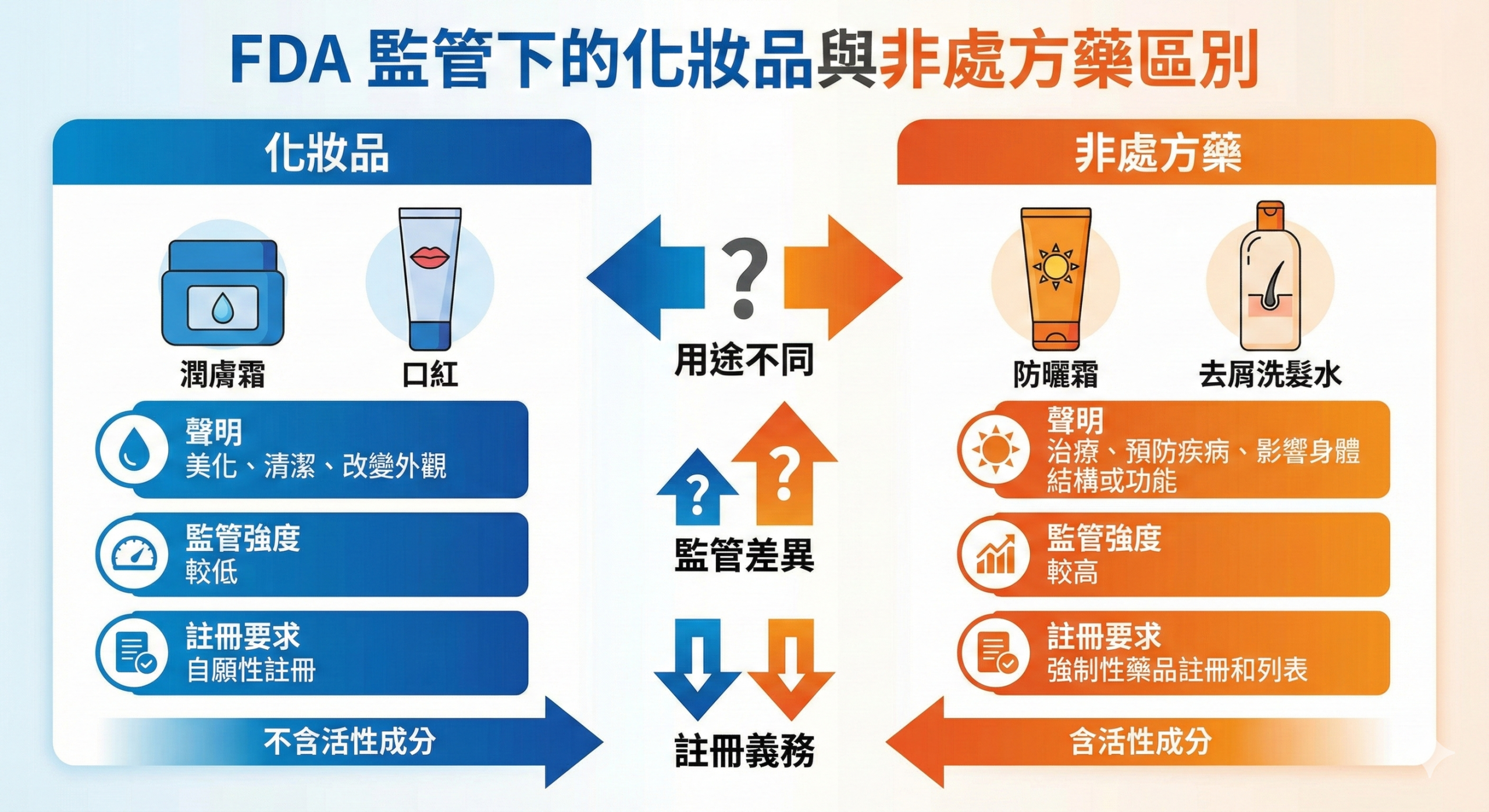
If you are further interested in the logic of the FDA classification of cosmetics and OTC drugs, you may refer to the related instruction page to clarify the key points of judgment in practice.
Before planning, it is recommended to establish a correct understanding of the overall system and logic of judgment, and then conduct an assessment according to their own conditions, which will help to reduce the uncertainty of subsequent decision-making and implementation.
For a systematic understanding of this topic, please refer to the full explanation organized by [Cross-border Security Judgment - Green Circle].
[Description
This article is for informational purposes only and is intended to assist in the understanding of the system and the logic of judgment, and does not constitute legal, regulatory or operational advice.
 EN
EN  ZH_TW
ZH_TW  ZH
ZH