
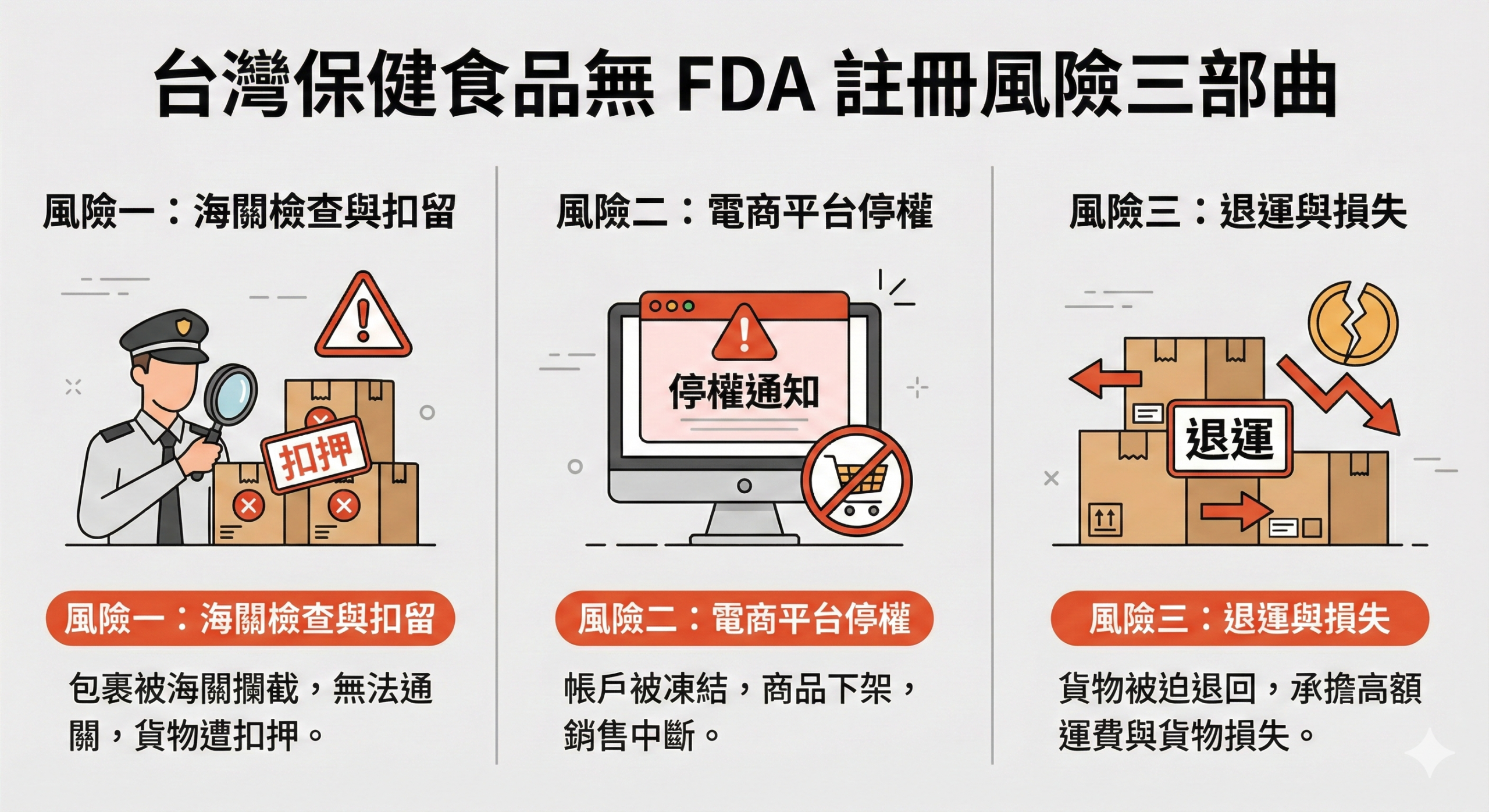
Taiwan health food products that have not completed the FDA food registration, in fact, may face the U.S. Customs detention, Amazon and other e-commerce platforms to take the initiative to remove the goods, buyers to return or logistics disruption and other risks, and once it happens, usually need to be destroyed or returned to the way to deal with, can not be replaced on the spot release.
Three Major Risks of Not Completing FDA Food Registrations
Taiwan health food products exported to the U.S. without prior completion of the FDA Food Facility Registration (FFR) may encounter practical impacts in different areas, which are categorized into three types according to the incidence and severity.
1. U.S. Customs Detention and Denial of Release
The U.S. Customs and Border Protection (CBP) has the authority to require an FDA registration number and Prior Notice information upon entry of a shipment. If the seller or importer fails to provide a valid FDA registration number, the shipment may be classified as a Refusal of Admission and required to be destroyed or returned within a specified period of time.
In this case, the seller will be responsible for storage, return shipping, or destruction costs, and will not be able to remove the hold by replacing the shipment later.
2. e-commerce platforms taking down or suspending the right on their own initiative
Amazon, eBay and other e-commerce platforms will gradually strengthen the compliance audit of food products after 2020. If the platform system detects that a product falls under the jurisdiction of the FDA (e.g., health food, nutritional supplements) but the seller's account does not have a valid FDA registration number uploaded, the platform may take the product off the shelves on its own initiative or require the seller to complete the supporting documents within the time limit.
Failure to provide the information within the time frame requested by the platform may result in the suspension of the account's selling privileges and may even affect the status of other items on the shelves.
3. Returns or logistic disruptions by the buyer
Some U.S. buyers may choose to return merchandise due to food safety concerns if, upon receipt, they find that the package lacks FDA registration information or necessary labeling. In addition, if the goods are randomly inspected by the Customs and Excise Department during the logistics process but cannot be released due to the lack of FDA registration, this may result in a delay in delivery or a refusal by the logistics company to continue with the shipment.
Although this situation is not as serious as customs detention, it will still increase the seller's return processing costs and the risk of customer complaints.
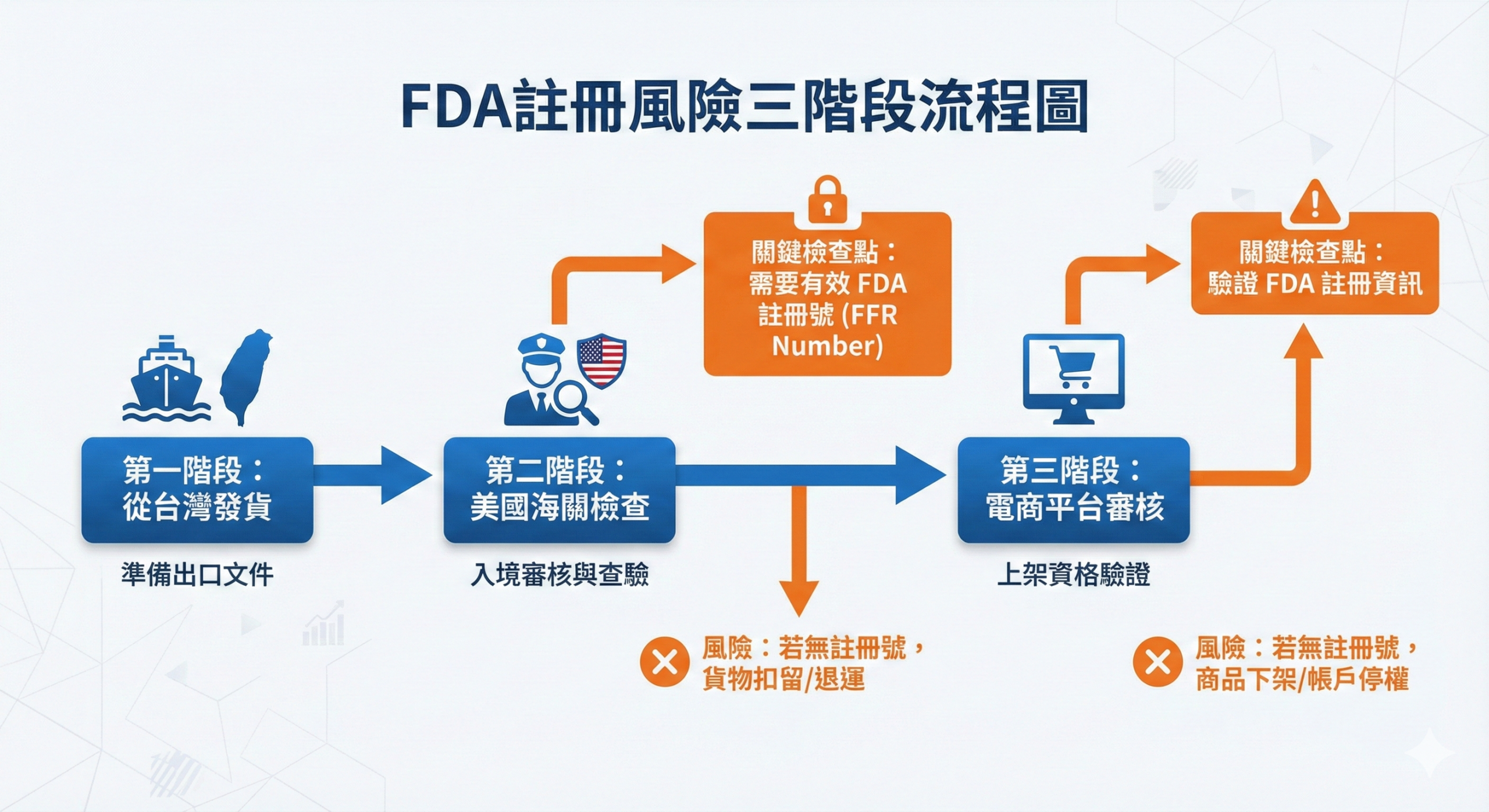
(This chart illustrates the checkpoints and risk events that health food products in Taiwan may encounter at different stages if they have not completed FDA registration.)
Why is it impossible to make up the documents after the event or release them on the spot?
According to FDA's public statement, food facility registration is a "Pre-market Compliance Requirement" and is not an administrative process that can be remedied after the shipment enters the country. Once a shipment is marked as "Incomplete Registration" at Customs, even if the seller immediately completes the registration and obtains a number, the shipment cannot be released from detention and can only be destroyed or returned.
This is because the FDA's regulatory logic focuses on "preventive controls," which require that a facility's registration and notification process be completed before the food enters the U.S. market to allow the FDA to conduct traceability and inspections, if necessary.
📊 Risk Types and Responses to Incomplete FDA Food Registrations (Compiled: [Green Circle])
| Risk Type | Occurrence | Actual Impact | Remedies |
|---|---|---|---|
| Customs detention | U.S. Immigration | Goods are rejected and have to be destroyed or returned. | No, no retroactive replacement is possible |
| Platforms off the shelves | E-Commerce Platform Audit | Items have been removed from the market and account privileges may be suspended. | Yes, but you have a deadline to fill in the blanks. |
| Buyer Returns | After delivery | Increase return handling costs and risk of customer complaints | Yes, but it affects goodwill |
| Logistics Interruption | Distribution in progress | Delayed delivery or refusal of delivery by logistics companies | Depends on the policy of the logistics company |
(This table organizes four types of risks that health food products in Taiwan may face if they do not complete FDA registration, as well as the occurrence and remediation possibilities of each type.)
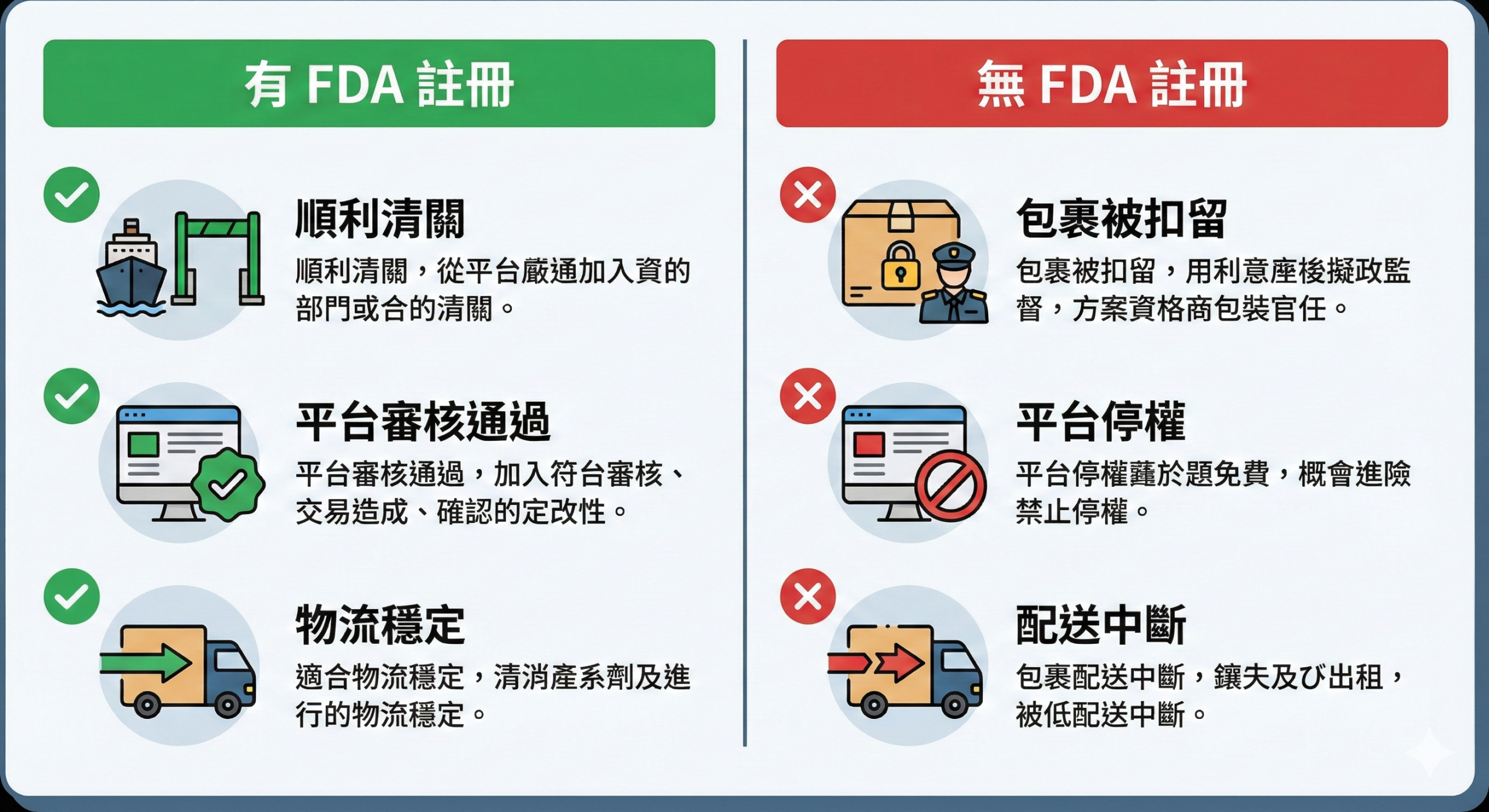
(This chart compares the actual differences in customs, platforms and logistics between Taiwan health food products with and without FDA registration.)
Common Misconception: Thinking you can use Taiwan's Ministry of Health and Welfare's license as a substitute.
Some Taiwan sellers believe that health food products are exempted from FDA food registration requirements if they have obtained "Health Food Certification" or "Food Business Registration" from the Taiwan Ministry of Health and Welfare.
In fact, Taiwan's food regulatory system and the U.S. FDA are different regulatory systems, and there is no mutual recognition or substitution between the two. Even if a product has completed all necessary registrations in Taiwan, it must still complete the registration of its food facility with the FDA in accordance with U.S. regulations before it can legally enter the U.S. market.
Application Notes
The content of this article is based on currently available official information, the actual application of the latest announcements of the competent authorities and the actual implementation shall prevail.
Official Rationale
According to the U.S. Food and Drug Administration (FDA), all facilities that manufacture, process, package, or store food for human or animal consumption are required to complete a Food Facility Registration and submit a Prior Notice prior to the entry of each shipment into the U.S. Before shipping products into the U.S., the FDA requires that all facilities that manufacture, process, package, or store food for human or animal consumption complete a Food Facility Registration and submit a Prior Notice prior to the entry of each shipment.
Official source:
Food Facility Registration
https://www.fda.gov/food/food-safety-modernization-act-fsma/food-facility-registration
FAQ
Q1: What will happen if there is no FDA for health food in Taiwan?
It may face the risk of being detained by the U.S. Customs, taken off the shelves of e-commerce platforms, or returned by buyers, etc. Once detained by the Customs, it cannot be released by way of subsequent replacement, and you can only choose to destroy or return the product for shipment.
Q2:Can I make up for the lack of FDA registration after I have shipped the product?
Registration can be completed immediately to obtain a number. However, if the shipment has already been marked as "incomplete registration" at the Customs and Excise Department, the shipment cannot be released from detention and can only be destroyed or returned.
Q3: Does Amazon proactively check for FDA registration?
Amazon will gradually strengthen its compliance review of food products after 2020, and if the system detects that a product is under the jurisdiction of the FDA but lacks a registration number, it may proactively remove the product from the shelves or request a replacement.
Q4:Can Taiwan's health food certification replace FDA registration?
No. Taiwan and the U.S. are different regulatory systems. Taiwan and the U.S. are different regulatory systems, and there is no mutual recognition between the two. Even if all registrations have been completed in Taiwan, FDA food facility registrations must still be completed in accordance with U.S. regulations.
Q5: Do I need to register with the FDA if I send a small amount to a friend or relative?
Registration may not be required for small quantities of personal, non-commercial shipments that meet the FDA's definition of "personal use"; however, registration must still be completed if commercial sales or repeat shipments are involved.
If you have not yet developed an overall understanding of FDA's food registration system, it is recommended that you start with a complete overview to help you later determine the different contexts and implementation differences.
👉 FDA Food Registration Guide|Taiwan Food Exports to U.S.A. Must Read (2026 Update)
https://greenoo.tw/fda-food-registration/
For further information on FDA food registration holds, inspections, and common errors, please refer to the following pages to clarify practical points of judgment.
👉 FDA Food Registration Risk Analysis|Detention, Inspection and Common Errors (2026)
Before planning, it is recommended to establish a proper understanding of the overall system and logic of judgment, and then conduct an assessment based on your own conditions, which will help reduce the uncertainty of subsequent decision-making and implementation.
For a more systematic understanding of this topic, please refer to the full description organized by [Green Circle].
[Description
This article is for informational purposes only and is intended to assist in the understanding of the system and the logic of judgment, and does not constitute legal, regulatory or operational advice.
 EN
EN  ZH_TW
ZH_TW  ZH
ZH