
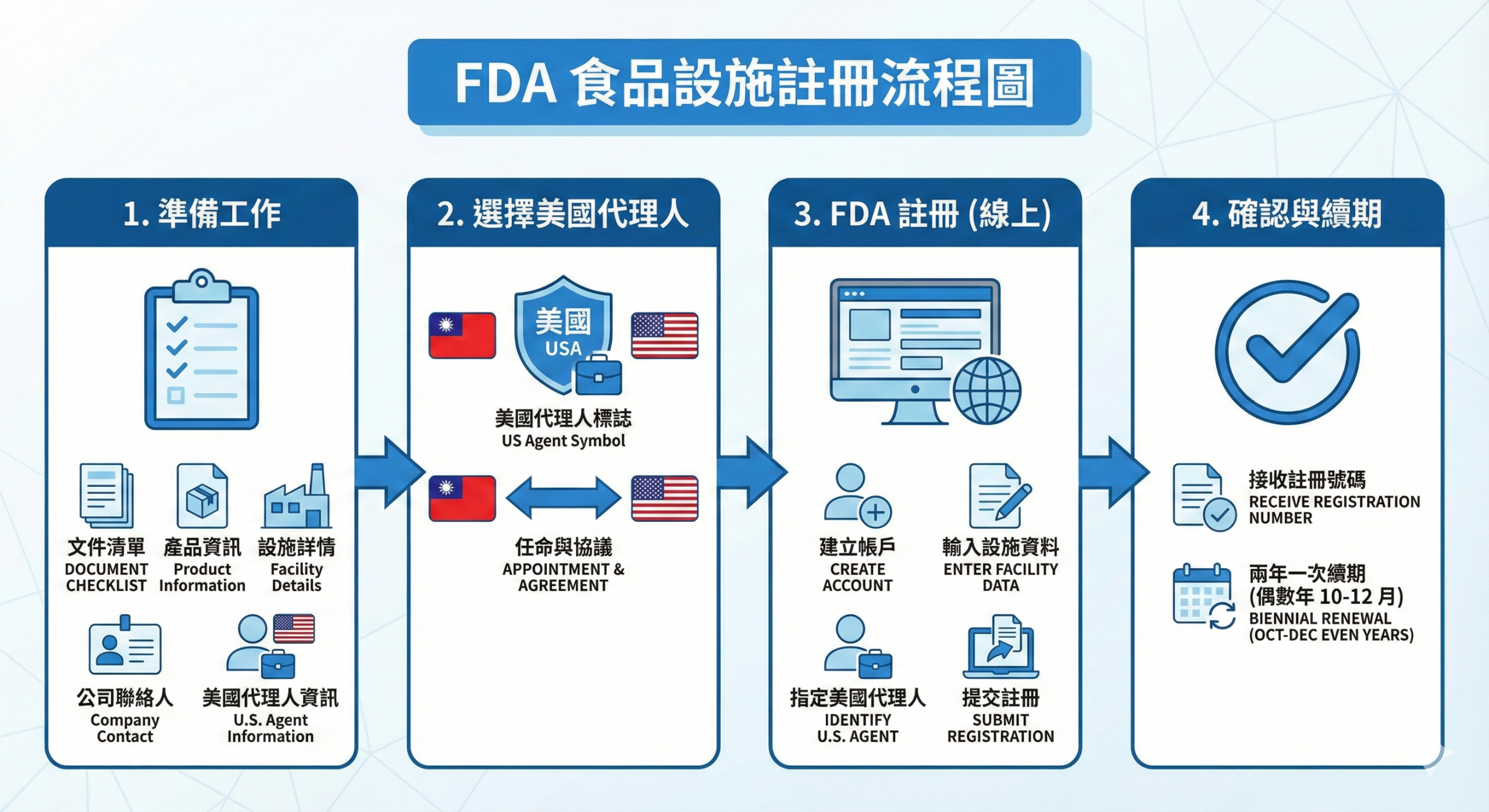
The completion of FDA food registration does not mean that the product can be sold directly in the United States.
Registration is only one of the prerequisites for compliance, and the actual sale of the product still needs to meet the requirements of product labeling, facility registration, import customs clearance and platform audit.
Institutional Positioning for FDA Registration
FDA food registration is a system of registering facilities required by U.S. federal regulations.
The aim is to establish traceability in the food supply chain.
Instead of directly granting a sales qualification.
Upon completion of registration, the
only means that the facility is registered with the FDA.
This does not mean that all conditions of sale have been met for the products produced at the facility.
Conditions of sale to be fulfilled after completion of registration
1. Product labeling complies with U.S. regulations
All foods sold in the U.S.
Must comply with FDA requirements for labeling content, format, and language.
Includes nutrition facts, allergen labeling, net content and manufacturer information.
Products with non-compliant labeling.
Even with FDA registration, the
They may still be detained at the point of importation or required to return the goods.
2. Facilities meet FSMA requirements
If the facility is required to comply with the Food Safety Modernization Act (FSMA).
such as preventive controls or supply chain management requirements.
The corresponding compliance work will need to be completed before sale.
facilities that do not meet FSMA requirements.
Even if you complete your registration, you will not be able to register for the program.
may still be subject to FDA inspections or import restrictions.
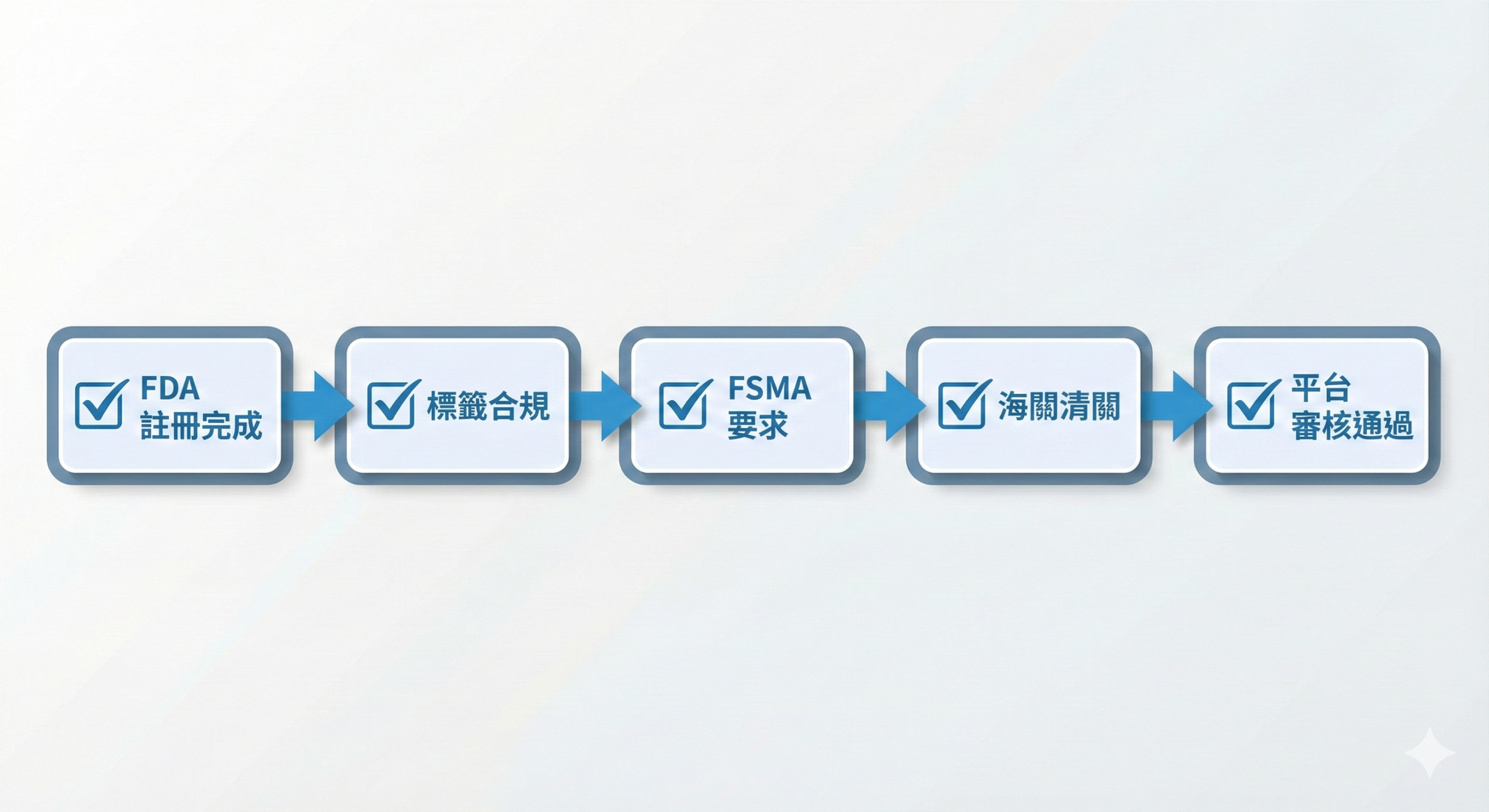
(This chart illustrates that after FDA registration is complete, a number of conditions such as labeling, facilities, customs and platforms must be met in order for actual sales to take place.)
Import Clearance and Customs Release
Completed FDA registration of the product.
It is still subject to U.S. Customs and Border Protection (CBP) inspection at the time of importation.
and FDA clearance.
If the product labeling, ingredients or packaging are not in compliance with the regulations.
You may still be required to make a replacement, hold the shipment, or return the shipment.
Additional Audit Requirements for Platform Sales
If you sell through Amazon, Walmart, etc., you'll be able to get a good deal.
Platforms often require sellers to provide proof of FDA registration, product labeling, and compliance documents.
and may be independently audited.
Platform review standards may be higher than the FDA base requirements.
Sellers are required to provide additional documentation or instructions as required by the Platform.
📊 Form Instructions: Judgment of conditions of sale after FDA registration is completed (Compilation of information: [green circle])
| Conditions of sale | Required for FDA registration | Whether or not necessary for actual sale | Possible consequences of non-compliance |
|---|---|---|---|
| FDA Facility Registration | be | be | Cannot be legally imported or sold |
| Product Labeling Compliance | clogged | be | Detention, return or fine |
| FSMA Preventive Controls | Depending on the type of facility | Depending on the type of facility | FDA Audits or Import Restrictions |
| Platform Audit Approval | clogged | Depending on the sales channel | Unavailable or Restricted |
Text description::
(This form states that FDA registration is only one of the conditions of sale and that actual sales are subject to a number of labeling, facility and platform requirements)
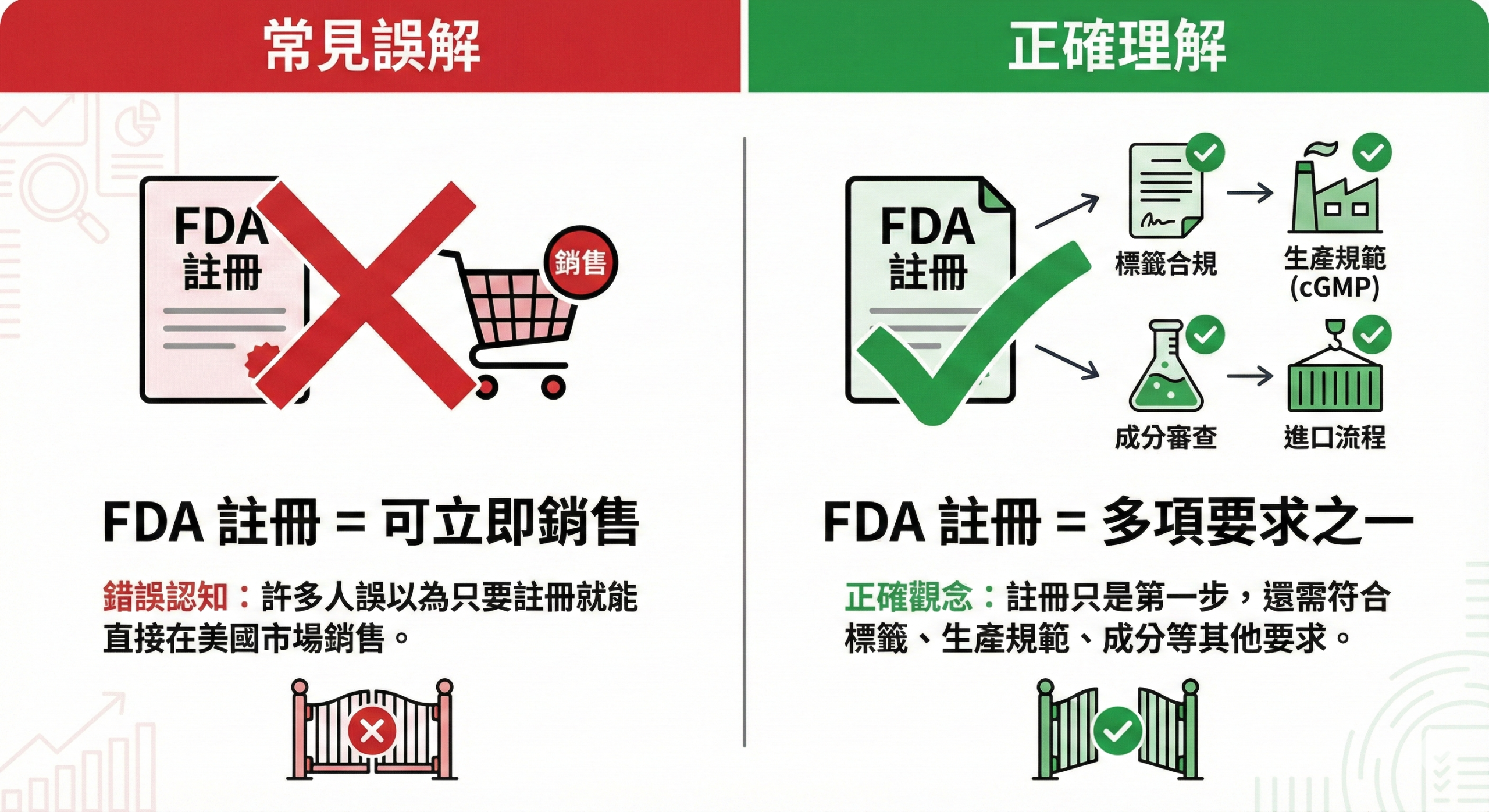
(This chart illustrates that FDA registration is not the same as direct sale, and that actual sale is still subject to labeling, facility and platform requirements.)
Common Misconceptions and Key Judgment Points
Misconception 1: Registration is complete and you can sell on the shelves.
FDA registration is for facility registration only.
It does not mean that the product has complied with the labeling, composition or packaging requirements.
Actual pre-sales
Conditions such as product labeling, facility compliance and platform audits still need to be confirmed.
Misconception 2: Registration will not be suspended if you have completed the registration.
Even with FDA registration, the
If the product labeling or ingredients do not comply with the regulations.
You may still be detained or asked to make up for it at the time of importation.
Import clearance and FDA registration are two separate processes.
Separate compliance is required.
[Application Notes
The content of this article is based on the current available official information.
The actual application is still subject to the latest announcement of the competent authorities and the actual implementation.
According to the U.S. Food and Drug Administration's (FDA) public statement.
Food Facility Registration (FFR) is a program that establishes the traceability of the food supply chain.
It is not a grant of sales qualification or product compliance certification.
Actual sales remain subject to the requirements of the Federal Food, Drug and Cosmetic Act (FD&C Act) and related regulations.
official source::
Food Facility Registration
https://www.fda.gov/food/food-facility-registration
FAQ
Q1: Can I sell in the U.S. after FDA registration?
No. FDA registration is for facility registration only, and actual sales are still subject to a number of conditions, including product labeling, facility compliance, import customs clearance and platform audits.
Q2:Will the product still be detained after completing FDA registration?
Possible. If the labeling or composition of the product does not comply with the requirements, it may be detained at the time of importation or required to be replaced, even if the registration is completed.
Q3: Will the Amazon platform accept proof of FDA registration?
The platform may require additional documentation, such as product labeling, ingredient descriptions, or declarations of compliance, and the standard of review may be higher than the FDA's basic requirements.
Q4:What do I need to do after FDA registration?
Confirm that the product labeling complies with U.S. regulations, that the facility meets FSMA requirements (if applicable), and prepare the necessary documentation for import customs clearance and platform audit.
Q5:Can Taiwan sellers judge whether they are eligible to sell?
It is recommended to check the product category, labeling requirements and facility compliance, and if necessary, consult with a professional advisor or U.S. agent to minimize subsequent risks.
If an overall understanding of the FDA's food registration system has not been established, it is important that you have a good understanding of the FDA's food registration system.
We recommend starting with the full overview.
It helps to determine the different contexts and implementation differences later on.
👉 FDA Food Registration Complete Guide|Must Read for Taiwan Food Exports to the U.S. (2026 Update)
https://greenoo.tw/fda-food-registration/
If you are interested in the FDA food registration application process and the required documents, please contact us.
Please refer to the following pages for more information.
to clarify the focus of the practical judgment.
👉 FDA Food Registration Process and Complete Documentation|Taiwan Application Highlights (2026)
FDA Food Registration Process and Documentation|Taiwan Application Highlights (2026)
Before proceeding with the relevant planning
It is recommended that a proper understanding of the overall system and the logic of judgment be established first.
Evaluate according to your own conditions.
Helps reduce uncertainty in subsequent decision-making and implementation.
For a systematic understanding of this topic, please contact
Please refer to the full description organized by [Green Circle].
[Description
This article is for informational purposes only.
To assist in the understanding of the system and the logic of judgment.
Does not constitute legal, regulatory or operational advice.
 EN
EN  ZH_TW
ZH_TW  ZH
ZH