
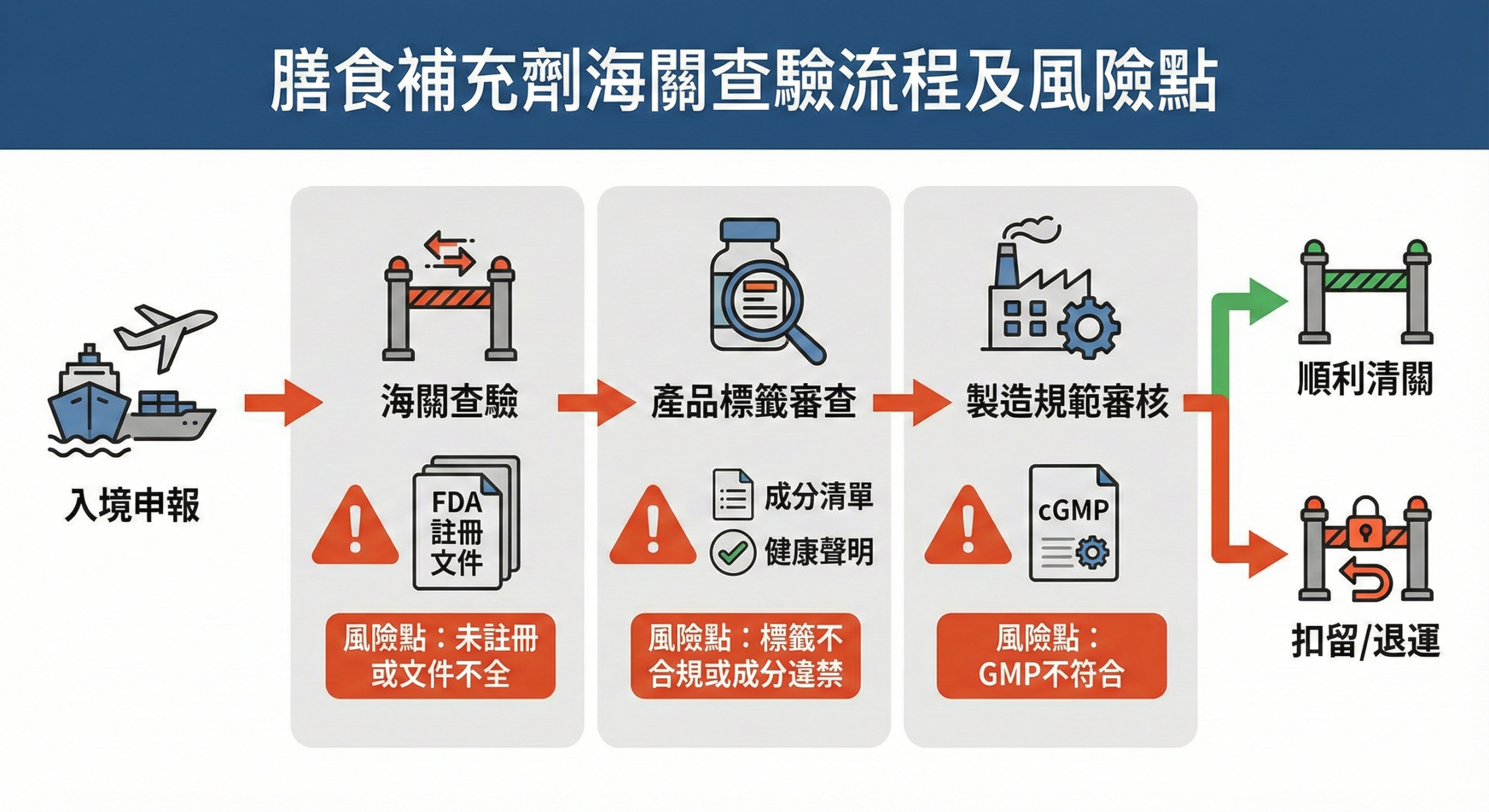
Because FDA food registration only confirms that the facility and product type are registered, it does not mean that the product labeling, ingredients, manufacturing process, or import documents comply with actual FDA regulations, and any discrepancies may still be subject to seizure or inspection.
FDA food registration is not the same as a customs bond.
FDA food registrations are "facility registrations" and "product class declarations", which are used to establish traceability mechanisms, not product compliance reviews. After registration, the product still needs to meet the following requirements in order to pass through customs smoothly:
- Product labeling meets FDA requirements for format and content.
- Complete list of ingredients and no prohibited ingredients
- Processes comply with CGMP (Good Current Practice)
- Imported documents are complete and consistent
If any of the components are not in compliance, C&ED may still carry out customs clearance or inspection in accordance with FDA regulations.
Common Reasons for Customs Deduction 1: Non-compliance with Labeling Requirements
Health food labeling must comply with the FDA's Supplement Facts format and must not contain claims for the treatment, prevention or diagnosis of disease. Common errors include:
- Incorrectly formatted or incomplete nutrition labels
- Use of unofficial terms for ingredient names
- Prohibited claims such as "treatment", "prevention", "improvement", etc. appear.
- Lack of required warnings or allergen labeling
Even after FDA registration is complete, mislabeling may trigger an automatic debarment.
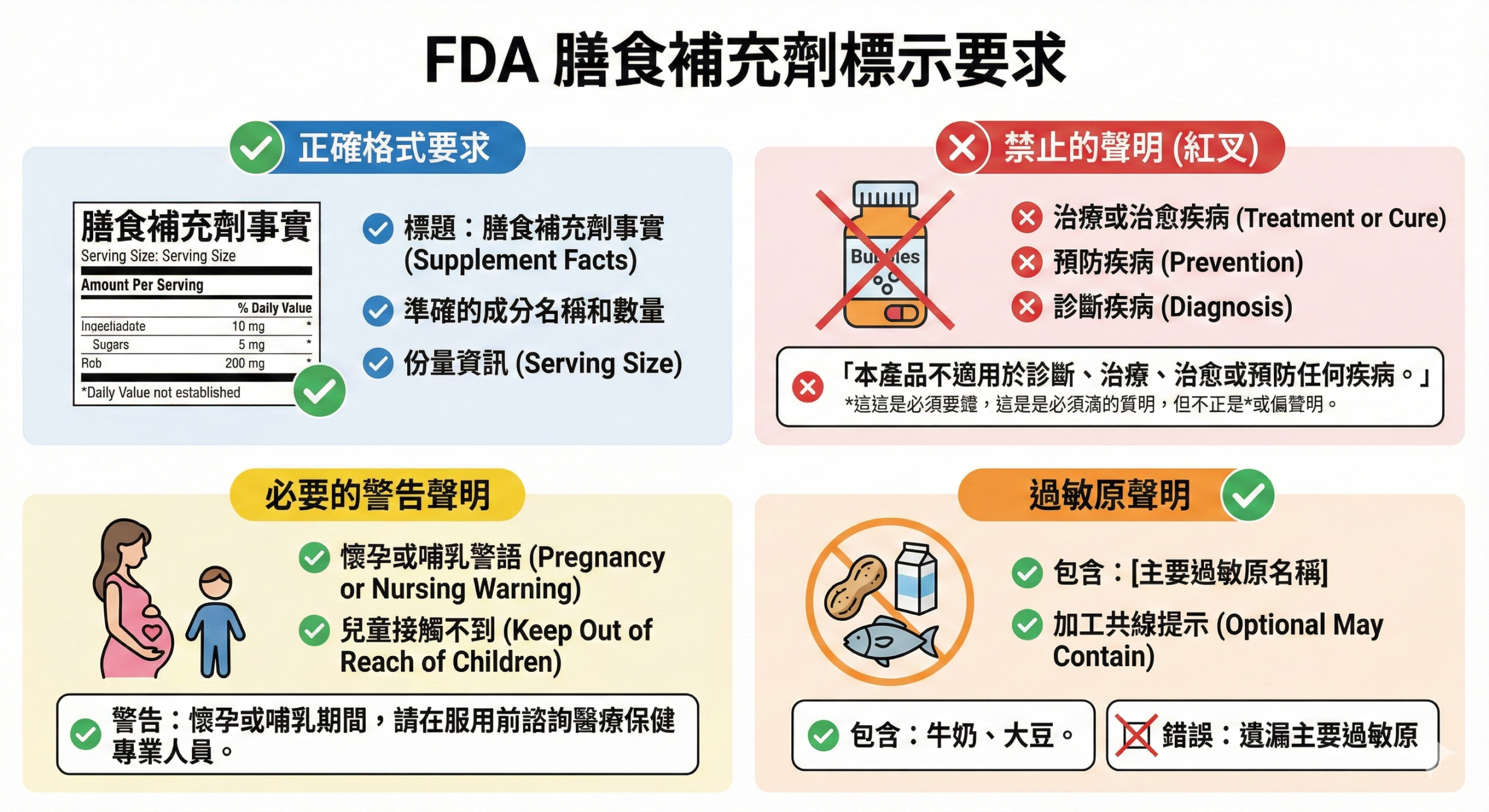
(This chart illustrates FDA's requirements for the format and content of health food labeling, as well as common types of errors)
Common Reasons for Customs Deduction II: Ingredient Problems
The FDA has clear restrictions on health food ingredients, including:
- Use of unapproved new dietary ingredients (NDIs)
- Contains prohibited ingredients or drug ingredients
- Ingredient dosage exceeding the safe upper limit
- Non-compliance with the source or purity of ingredients
If the product contains controversial ingredients or fails to comply with the NDI notification requirements, it may be subject to customs clearance even after registration is completed.
Common Reason 3: Process Discrepancy with CGMP
The FDA requires health food manufacturers to comply with the CGMP regulations in 21 CFR Part 111, including:
- Raw Material Acceptance and Inspection Procedures
- Production Environmental Hygiene Management
- Batch record completeness
- Inspection and Sampling of Finished Products
FDA inspections that reveal process deficiencies or failure to provide CGMP documentation at the time of importation may trigger a seizure or denial of importation.
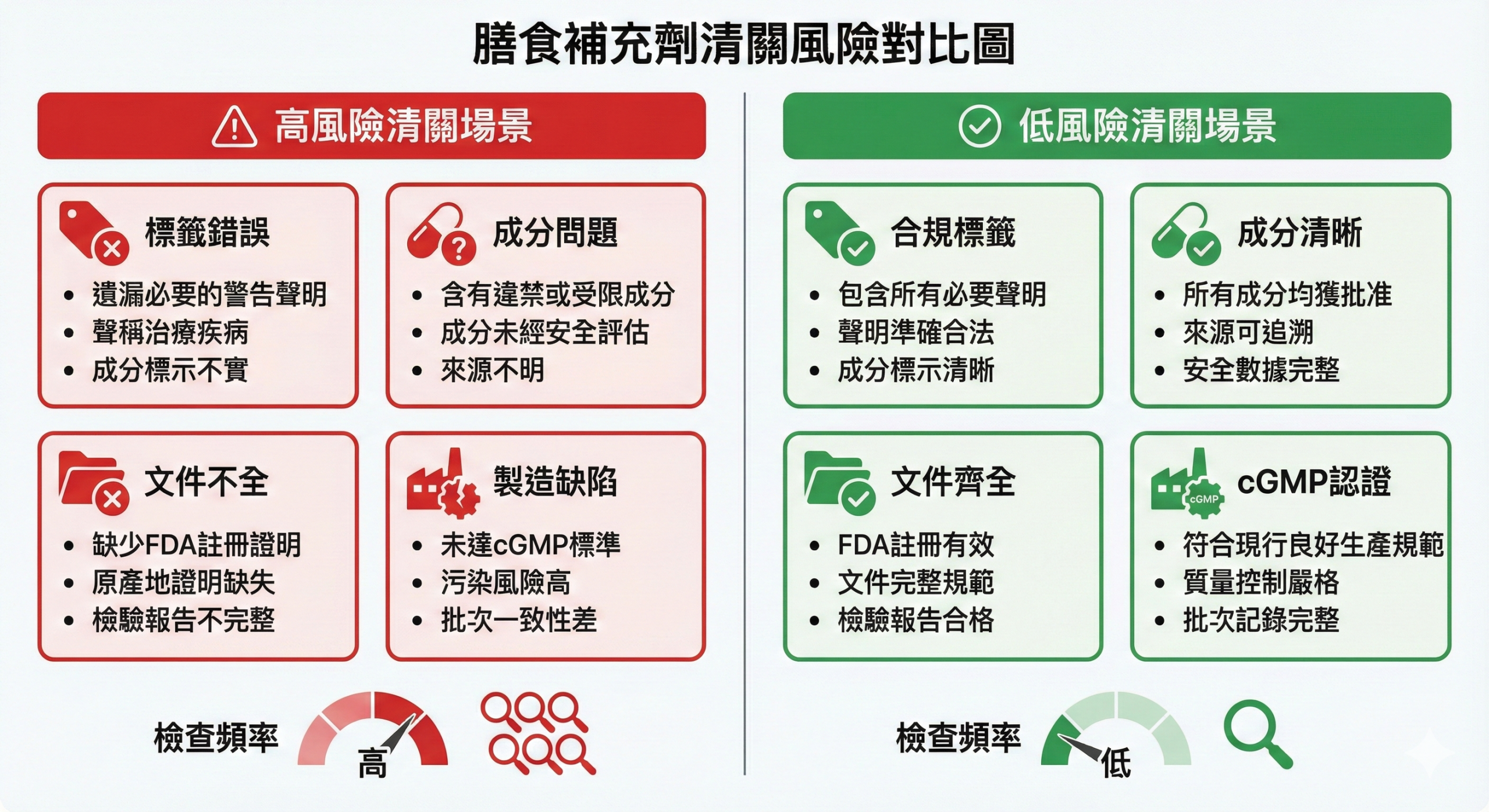
(This chart illustrates the differences in the risk of haircutting in different scenarios and the key points of practical judgment in risk reduction)
Common Reason for Customs Deduction 4: Incomplete import documents or inconsistent information
Complete documentation is required for the importation of health food products, including:
- FDA Food Registration Number
- A copy of the ingredient list and labeling
- Manufacturer's CGMP certification or factory inspection report
- Importer's Certificate
If the information on the documents does not match with the actual product, or if key documents are missing, the Customs may request for replacement or direct detention.
📊 Form InstructionsCommon Reasons for Detention and Key Points for Determination of Health Food Products (Compendium of Information: [Green Circle])
| Type of reasons for deduction | Common Trigger Scenarios | Key Points of Judgment |
|---|---|---|
| Discrepancies in labeling | Formatting errors, prohibited claims, lack of warnings | Compliance with Supplement Facts |
| Ingredients | Prohibited Ingredients, Undeclared NDIs, Dosage Exceeding Standards | Whether it contains controversial ingredients or unapproved new ingredients |
| Missing Programs | CGMP anomaly, poor factory inspection record | Is there a CGMP certificate or factory inspection record? |
| Documents are not in order | Incorrect registration number, missing ingredient list | Whether the documentation information is consistent with the product |
(This table organizes the common reasons for health food deduction and the key points of practical judgment to help Taiwan sellers to establish risk awareness)
How to Reduce Customs Risks
Although it is not possible to avoid checking completely, you can minimize the chance of a customs clearance by doing the following:
- Verify labeling compliance with the latest FDA regulations prior to shipment.
- Avoiding controversial or unapproved new ingredients
- Maintain complete process logs and CGMP certification files.
- Ensure that import documents are complete and information is consistent.
- Regularly review FDA warning lists and checkpoints.
Establishing a proper understanding will minimize the risk of chargebacks due to information discrepancies.
[Application Notes
The content of this article is based on currently available official information, the actual application of the latest announcements of the competent authorities and the actual implementation shall prevail.
[Official Supporting Documents
According to the FDA's official instructions, food registrations are only for facilities and product categories, and do not mean that the product has passed compliance review; actual importation still requires compliance with multiple regulations on labeling, ingredients, manufacturing processes and documentation.
official source::
FDA Food Facility Registration
https://www.fda.gov/food/food-facility-registration
Dietary Supplements - Label Claims
https://www.fda.gov/food/dietary-supplements/dietary-supplements-label-claims
Current Good Manufacturing Practice in Manufacturing, Packaging, Labeling, or Holding Operations for Dietary Supplements
https://www.fda.gov/food/dietary-supplements/current-good-manufacturing-practice-cgmp-regulations-dietary-supplements
FAQ
Q1: Why are many health food products with FDA still being held up?
Because FDA food registration only confirms that the facility and product type are registered, it does not mean that the product labeling, ingredients, manufacturing process or documentation are in compliance with regulations, and non-compliance in any of these areas may still result in a detainer.
Q2: What else do I need to pay attention to after completing FDA registration?
It is necessary to confirm that the labeling complies with Supplement Facts, the ingredients are free of prohibited or unapproved items, the manufacturing process complies with CGMP, and the import documents are complete and the information is consistent.
Q3:Will the wrong labeling lead to a direct suspension?
Possible. Labeling with prohibited claims, incorrect formatting, or missing required warnings may trigger an automatic hold or request for a replacement.
Q4: How can I verify that the ingredients are FDA compliant?
Check the official FDA list of prohibited ingredients, NDI notification requirements, and whether there are any related warnings or enforcement cases.
Q5: What documents can be retained to reduce the risk of Customs Deduction?
It is recommended to keep a complete list of ingredients, a copy of the labeling, CGMP certification, factory inspection report, FDA registration number, and proof of importer's qualifications.
If you have not yet developed an overall understanding of FDA's food registration system, it is recommended that you start with a complete overview to help you later determine the different contexts and implementation differences.
👉 FDA Food Registration Guide|Taiwan Food Exports to U.S.A. Must Read (2026 Update)
https://greenoo.tw/fda-food-registration/
For further information on FDA food registration holds, inspections, and common errors, please refer to the following pages to clarify practical points of judgment.
👉 FDA Food Registration Risk Analysis|Detention, Inspection and Common Errors (2026)
FDA Food Registration Risk Analysis|Detention, Inspection and Common Errors (2026)
Before planning, it is recommended to establish a proper understanding of the overall system and logic of judgment, and then conduct an assessment based on your own conditions, which will help reduce the uncertainty of subsequent decision-making and implementation.
For a more systematic understanding of this topic, please refer to the full description organized by [Green Circle].
[Description
This article is for informational purposes only and is intended to assist in the understanding of the system and the logic of judgment, and does not constitute legal, regulatory or operational advice.
 EN
EN  ZH_TW
ZH_TW  ZH
ZH