
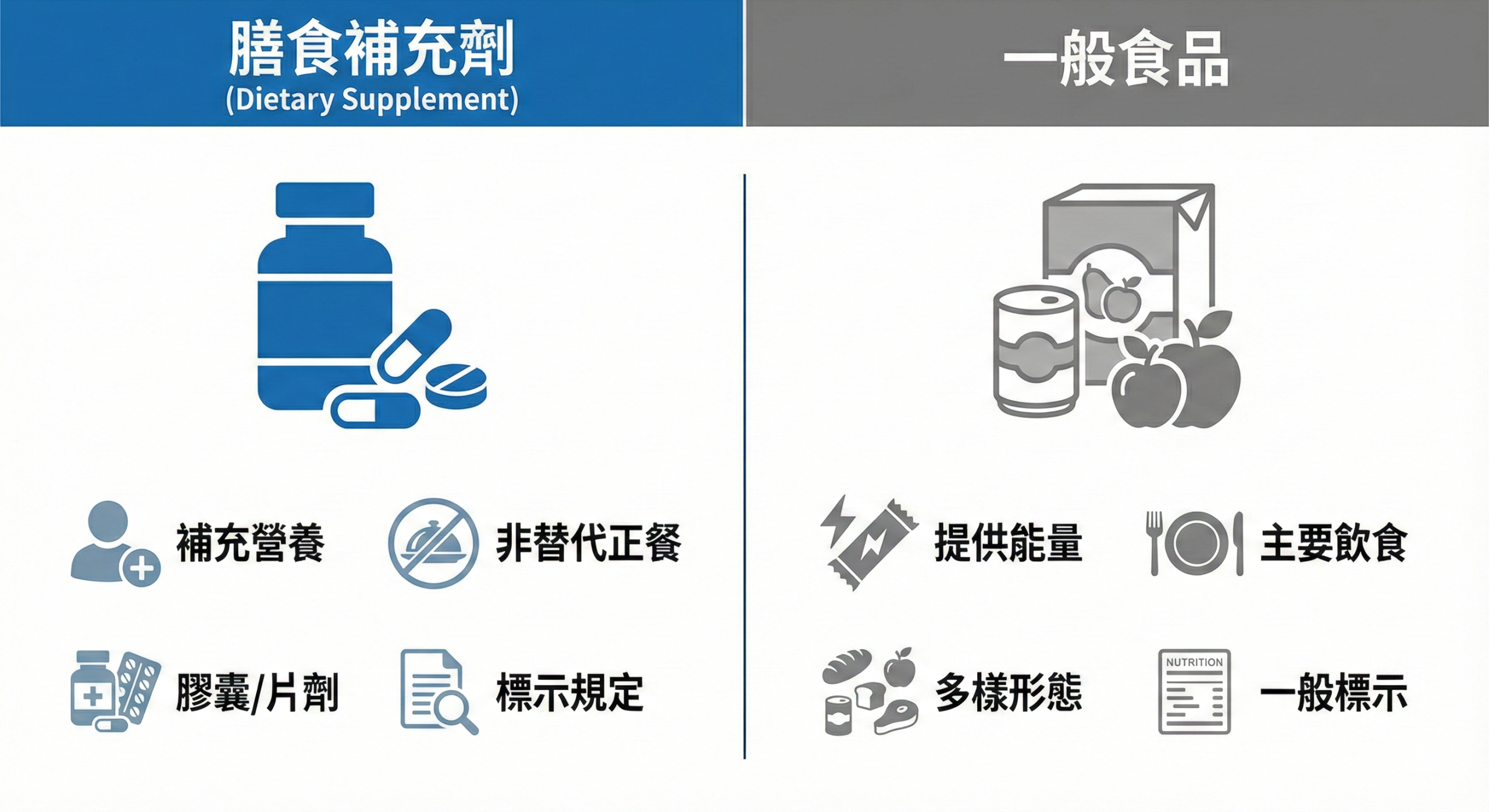
Dietary supplements and food products are subject to different FDA registration regimes, with the main differences being registration targets, labeling requirements, and inspection standards. Dietary supplements are subject to facility registration and product labeling notification, while general foods are subject to facility registration and prior notification.
Differences in the definitions of dietary supplements and general foods
Under the FDA system, the classification of Dietary Supplement and Conventional Food is based on the use of the product and the form of the ingredients.
Dietary supplements are usually supplied in the form of capsules, lozenges, powders or liquids, labeled as "Supplement Facts" and must not claim to treat or prevent disease. General food products are intended for daily consumption and are labeled as "Nutrition Facts" and can be in solid or liquid form.
If a product meets the characteristics of both a food and a dietary supplement, the category of applicability must be determined by the primary use and labeling.
Differences between registered objects and programs
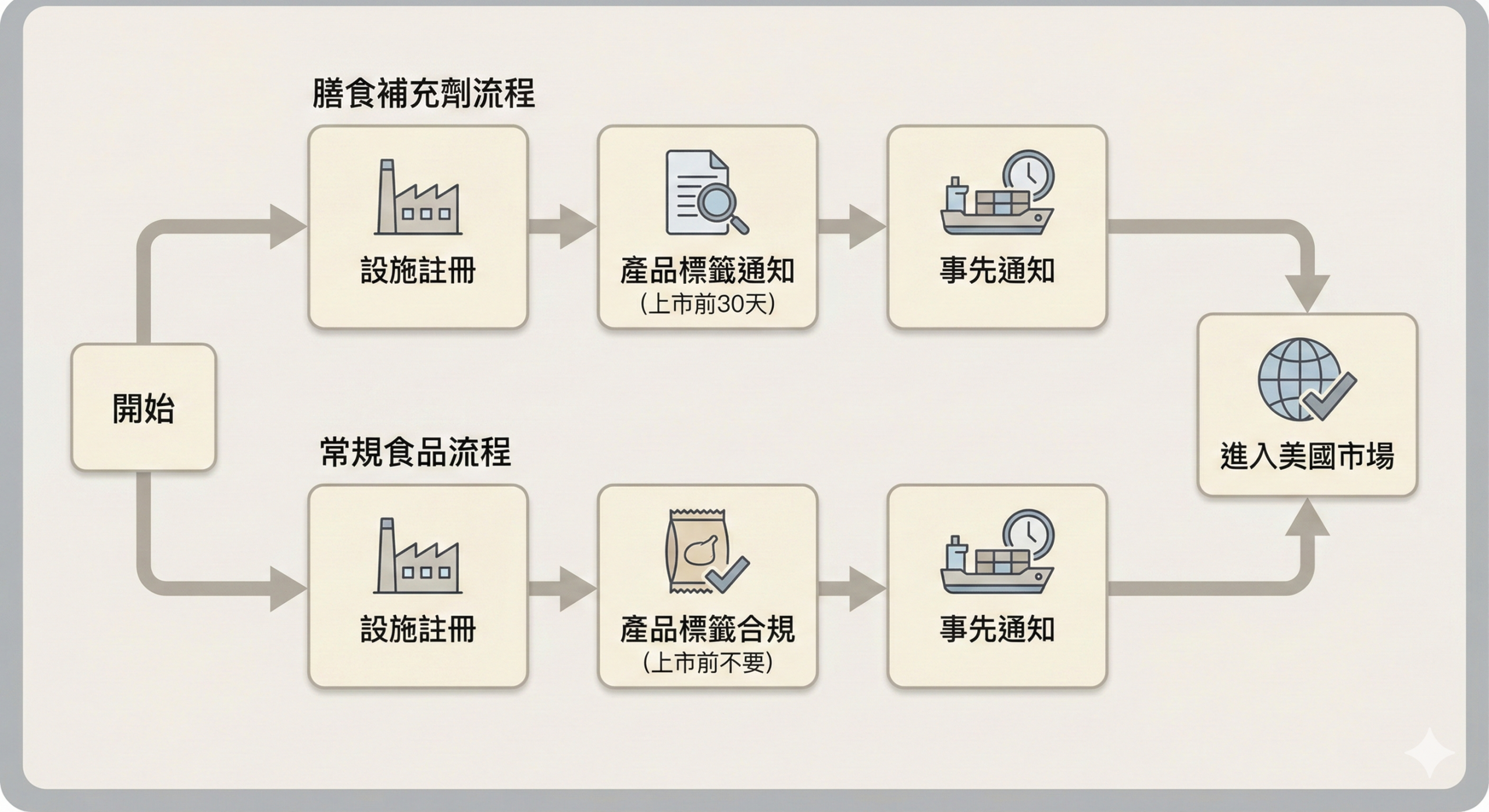
(This chart illustrates the major differences in the registration process and target audience between dietary supplements and general food products)
Dietary supplements require two processes: Facility Registration and Label Notification. Facility Registration is for establishments that manufacture, package or hold dietary supplements, and Label Notification must be completed before the product can be marketed.
General food products are also subject to facility registration, but product labeling is not mandatory. For imported products, a Prior Notice must be submitted prior to the arrival of the shipment, stating the contents of the product, the source and the scheduled time of arrival.
Taiwan sellers who ship through third-party logistics or agents need to confirm the responsibility of facility registration to avoid customs clearance due to incomplete registration.
Labeling Requirements and Compliance Judgment
Dietary supplement labeling must comply with the "Supplement Facts" format, listing the amount per serving, the recommended daily intake percentage, and labeled with disclaimers such as "This statement has not been evaluated by the FDA".
General food labels use the "Nutrition Facts" format, which must list nutrients such as calories, fat, carbohydrates, etc., and comply with the FDA's requirements for allergen labeling.
Incorrect labeling or mixing of two formats may be considered as labeling inconsistency, which may result in the product not being able to clear customs or being asked to be removed from the shelves.
Inspection Standards and Risk Differences
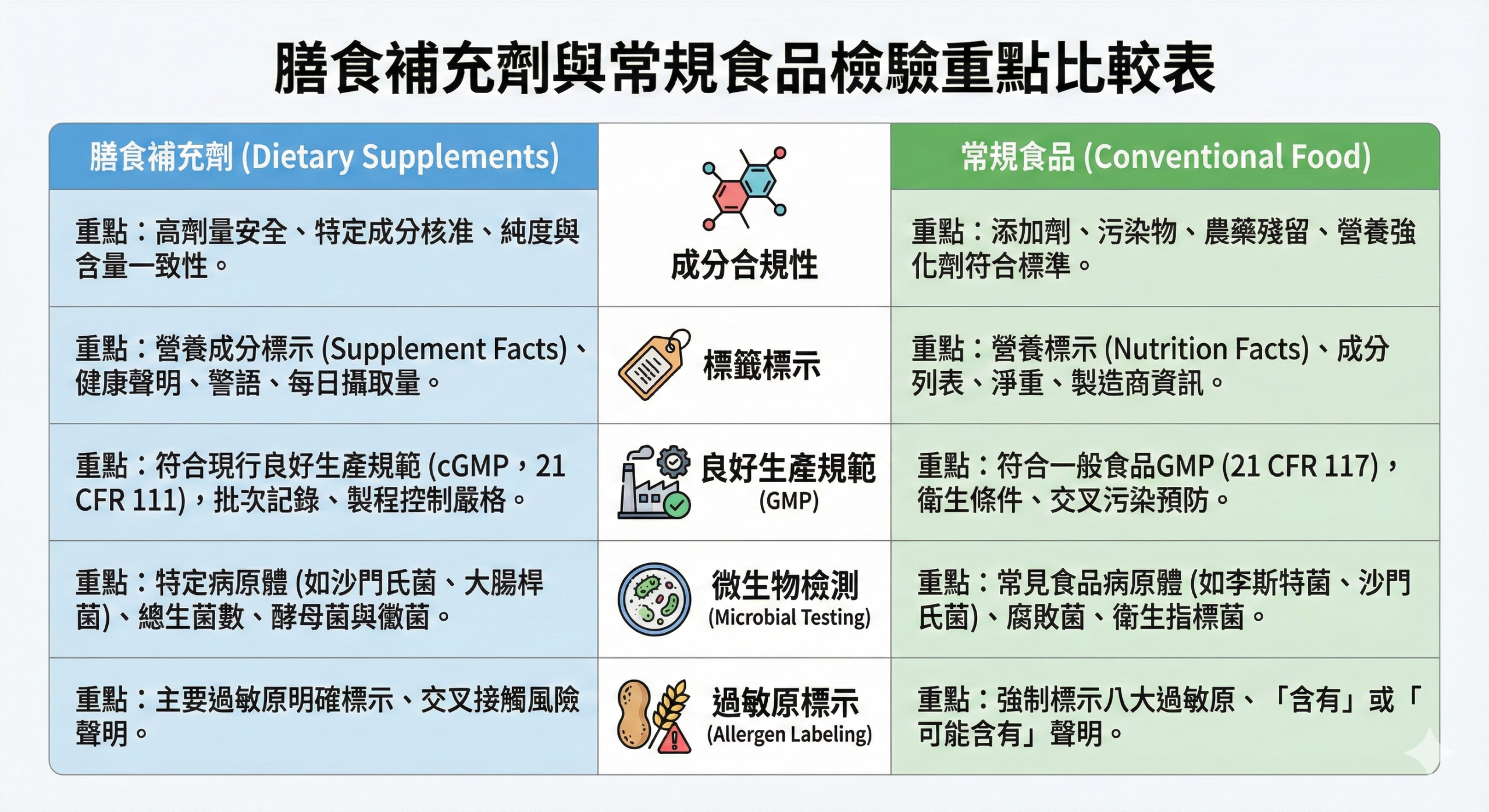
(This chart illustrates the major differences in testing standards and risk types between dietary supplements and general food products)
Dietary supplement testing focuses on ingredient compliance, labeling integrity and GMP (Good Manufacturing Practice) compliance. If the product contains unapproved New Dietary Ingredient (NDI), a safety assessment report must be submitted in advance.
General food inspections focus on microbiological testing, allergen labeling, and prior notification accuracy. If the product is canned or low-acid, it must additionally comply with FDA process control requirements.
Taiwan sellers are advised to check with the FDA or a professional consultant beforehand if the classification of their products is not clear, in order to avoid misclassification that may lead to non-compliance with inspection or product recalls.
Form InstructionsDietary Supplements and Foods: Differences in FDA Registration (Compiled by: [Green Circle])
| Judgmental Items | Dietary Supplements | General foodstuffs |
|---|---|---|
| Labeling Format | Supplement Facts | Nutrition Facts |
| Facility Registration | Must | Must |
| Product Labeling Notification | Must | non-mandatory |
| Pre-announcement | Required for import | Required for import |
| GMP Requirements | Applicable | Some products are applicable |
| Checkpoints | Ingredient compliance, complete labeling | Microorganisms, Allergens, Markers |
(This table organizes the major differences in FDA registration between dietary supplements and food products to help quickly determine the applicable regimes.)
If a product is characterized as both a food and a dietary supplement, a determination of classification is made based on the primary use, labeling, and distribution channel. If a determination cannot be made, it is recommended that a Product Classification Request be submitted to FDA in advance.
[Application Notes
The content of this article is based on currently available official information, the actual application of the latest announcements of the competent authorities and the actual implementation shall prevail.
[Official Supporting Documents
According to FDA's public statement, dietary supplements and general food products are subject to different registration and labeling systems, and the classification of a product must be based on the form of its ingredients, its use, and the way it is labeled.
official source::
Dietary Supplements - FDA
https://www.fda.gov/food/dietary-supplements
Food Facility Registration - FDA
https://www.fda.gov/food/food-safety-modernization-act-fsma/fsma-final-rule-foreign-supplier-verification-programs-fsvp-importers-food-humans-and-animals
Frequently Asked Questions (FAQ)
Q1: What is the difference between dietary supplements and general food FDA registration?
Dietary supplements require facility registration and product labeling notification, while general food products only require facility registration and prior notification (if applicable). The labeling format, inspection criteria and compliance requirements are different between the two.
Q2: How to determine whether a product should be categorized as a dietary supplement or a general food?
Judgement is based on the form of the product, the contents of the label and the main purpose of the product. If the product is supplied in the form of capsules or tablets and labeled with "Supplement Facts", it is usually classified as a dietary supplement.
Q3: What should I do if my product is not categorized correctly in Taiwan?
It is recommended that a Product Classification Request be submitted to FDA or a professional consultant be engaged to assist in making a determination to avoid a misclassification that could result in an inspection discrepancy.
Q4: Do dietary supplements need to meet GMP requirements?
Yes. Dietary supplement manufacturers are required to comply with FDA's GMP regulations to ensure that quality standards are met during the manufacturing, packaging, and storage of their products.
Q5: Is product labeling notification required for general food products?
Product labeling notification is not mandatory for general food products, but additional processing control requirements need to be met if the products are canned or low-acid.
If you have not yet developed an overall understanding of FDA's food registration system, it is recommended that you start with a complete overview to help you later determine the different contexts and implementation differences.
👉 FDA Food Registration Complete Guide|Must Read for Taiwan Food Exports to the U.S. (2026 Update)
https://greenoo.tw/fda-food-registration/
For further information on the FDA food registration application process and required documents, please refer to the following pages to clarify practical points of judgment.
👉 FDA Food Registration Process and Complete Documentation|Taiwan Application Highlights (2026)
Before planning, it is recommended to establish a proper understanding of the overall system and logic of judgment, and then conduct an assessment based on your own conditions, which will help reduce the uncertainty of subsequent decision-making and implementation.
For a more systematic understanding of this topic, please refer to the full description organized by [Green Circle].
[Description
This article is for informational purposes only and is intended to assist in the understanding of the system and the logic of judgment, and does not constitute legal, regulatory or operational advice.
 EN
EN  ZH_TW
ZH_TW  ZH
ZH